Construction Site Theft Statistics: What Project Managers Need to Know

Construction site theft is not an occasional inconvenience — it is a persistent, industry-wide problem that costs U.S. contractors hundreds of millions of dollars every year. If you manage construction projects, the odds are that your sites have already been affected, or will be. Understanding the scale of the problem, what gets stolen, when it happens, and what actually prevents it is the first step to protecting your projects and your bottom line. Construction site surveillance cameras are one of the most effective and cost-efficient tools available to address all three.
This post compiles the most current construction site theft statistics from credible industry sources — including the National Equipment Register (NER), the National Insurance Crime Bureau (NICB), Engineering News-Record, and CONEXPO-CON/AGG — so you have the data you need in one place.
Construction Site Theft by the Numbers
Here is a summary of the key construction site theft statistics from recent industry data:
| Statistic | Source |
| $300M – $1B+ | Estimated annual losses from construction site theft in the U.S. (NER / NICB) |
| 11,000+ | Construction equipment theft incidents reported annually in the U.S. (NICB) |
| ~$30,000 | Average cost of a single equipment theft incident (National Equipment Register / CONEXPO 2025) |
| Less than 25% | Recovery rate for stolen construction equipment — most is never found (NER / Deep Sentinel) |
| ~$1B annually | Value of copper alone stolen from construction sites each year (U.S. Department of Energy) |
| ~85% | Estimated percentage of construction site thefts that go unreported to authorities |
| ~70% | Percentage of construction workers who witness theft on job sites annually (BauWatch 2024) |
| ~50% | Estimated share of thefts involving internal personnel — employees or subcontractors |
| ~42% | Reduction in theft likelihood for sites with visible surveillance (vs. unmonitored sites) |
| August | The month with the highest construction site theft rate — peak construction season (WCCTV / NER) |
The Scale of the Problem: How Much Is Being Stolen?
Annual loss estimates for construction site theft in the United States consistently land in a range of $300 million to over $1 billion, depending on the source and what is included in the calculation. The National Equipment Register and NICB have historically placed direct equipment theft losses in this range — and that figure does not include indirect costs such as project delays, increased insurance premiums, labor idle time, and rental equipment to replace stolen assets.
| $400M – $1B in annual construction site theft losses — not including project delay costsSource: Engineering News-Record / National Equipment Register |
The difference between the low and high end of that range depends largely on what is counted. Equipment theft alone — tracked by law enforcement and insurance claims — tends to produce more conservative estimates. When materials theft (copper, lumber, steel, HVAC components), tools, and unreported incidents are included, the total loss figure climbs substantially.
For individual contractors, the relevant number is not the industry aggregate — it is the average cost per incident. According to the National Equipment Register, the average single construction equipment theft costs approximately $30,000. For a small or mid-sized contractor, a single incident of that magnitude can wipe out the margin on an entire project.
What Gets Stolen from Construction Sites?
Theft on construction sites falls into three broad categories: equipment, materials, and tools. Each has different risk profiles and different implications for project continuity.
Heavy Equipment
Excavators, skid steers, loaders, generators, and trailers are among the most targeted items. They are high value, often left unattended overnight, and — because most lack GPS tracking — difficult to recover once stolen. CONEXPO-CON/AGG data from 2023 noted nearly 1,000 pieces of construction equipment stolen per month across the U.S., a rate consistent with NICB annual reporting.
Materials
Copper is the single most stolen material from construction sites, with the U.S. Department of Energy estimating $1 billion in copper theft annually across all industries — construction sites being among the primary targets. Lumber, steel, aluminum, HVAC components, and plumbing fixtures are also frequently targeted, particularly as material costs have increased significantly since 2020.
Tools and Small Equipment
Power tools account for approximately 41% of all construction site thefts, followed by hand tools at around 23% and small equipment at 15%, according to industry data. Tools are attractive targets because they are portable, easy to resell, and rarely serialized in a way that enables recovery.
| Power tools account for ~41% of all construction site thefts — the single most stolen categorySource: Industry theft data compiled by Gitnux / NER |
When Does Theft Happen?
The timing of construction site theft follows predictable patterns that project managers should factor into their security planning.
Overnight and Weekends
Approximately 70% of construction site thefts occur at night, according to industry data. Weekend theft is particularly common — sites are unstaffed, activity is minimal, and the window of opportunity is long. The National Equipment Register has documented recurring theft spikes around long holiday weekends, including Memorial Day, Labor Day, and Thanksgiving, when sites may be unattended for three or more consecutive days.
Peak Construction Season
August consistently records the highest construction site theft rates in the U.S., coinciding with peak construction activity and the corresponding concentration of high-value equipment and materials on active sites. The second half of the year — when many projects are in full swing — tends to see elevated theft rates relative to the first half.
Supply Chain Disruptions
Approximately 60% of construction companies report increased theft incidents during periods of supply chain disruption, according to industry surveys. When materials are scarce and expensive, their value as targets increases proportionally — making security more important precisely when replacement costs are highest.
The Recovery Problem: Why Stolen Equipment Is Usually Gone for Good
One of the most striking facts about construction site theft is how rarely stolen equipment is recovered. The National Equipment Register places the recovery rate at less than 25% for most categories of construction equipment. Some studies put it even lower — around 7% for individual items — compared to roughly 60% for passenger vehicles.
| Less than 25% of stolen construction equipment is ever recoveredSource: National Equipment Register / WCCTV |
The low recovery rate reflects several structural issues. Most construction equipment lacks the built-in GPS tracking that is now standard in passenger vehicles. Equipment identification numbers (EINs) are often not recorded before theft, making it difficult for law enforcement to identify or trace recovered items. And organized theft rings frequently move stolen equipment across state lines or out of the country within hours of the incident.
The practical implication for project managers is straightforward: once equipment is stolen, it is almost certainly gone. The only effective strategy is prevention.
The Hidden Costs Beyond the Stolen Items
The direct replacement cost of stolen equipment and materials is only part of the financial impact. Construction site theft generates a cascade of secondary costs that compound the damage:
- Project delays: Missing equipment halts work completely. Each delayed day increases labor costs and risks contractual penalties. Industry estimates put project delay costs from theft at an average of $10,000 per day.
- Insurance premium increases: Frequent theft claims lead insurers to classify a contractor as high-risk, resulting in higher premiums. Some contractors face policy cancellations after repeated incidents.
- Rental costs: Replacing stolen equipment with rentals while permanent replacements are sourced adds significant cost, particularly given post-pandemic equipment pricing increases of over 20%.
- Administrative burden: Filing police reports, insurance claims, and managing the procurement of replacement equipment consumes management time that would otherwise go toward project delivery.
- Reputational impact: Theft-related delays affect client relationships and can damage a company’s standing with general contractors and developers who depend on schedule reliability.
The total cost of a single theft incident — direct and indirect — can easily reach two to three times the value of what was stolen.
The Insider Threat: Theft by Employees and Subcontractors
Not all construction site theft comes from external actors. Industry data suggests that approximately 50% of construction site theft involves internal personnel — employees, subcontractors, or vendors with legitimate site access. The BauWatch 2024 Construction Crime Index found that 70% of construction workers report witnessing theft on job sites annually.
Insider theft is particularly difficult to detect because perpetrators already have legitimate access and knowledge of the site layout, schedules, and security blind spots. It is also frequently underreported — supervisors may be reluctant to pursue claims against workers or subcontractors with whom they have ongoing relationships.
Facial recognition and vehicle detection technology address this problem directly. By maintaining a complete, timestamped log of every person and vehicle entering and exiting the site, project managers have an objective record of who was on site during any given time window — regardless of whether anyone witnessed an incident in person.
What the Data Says About Prevention
The theft statistics are discouraging — but the prevention data is genuinely encouraging. Multiple sources point to specific, measurable reductions in theft when targeted security measures are in place:
- Visible surveillance cameras reduce theft likelihood by approximately 42% compared to unmonitored sites, according to industry research.
- Access control systems lower theft incidents by approximately 37% when properly implemented.
- Perimeter fencing, when combined with surveillance, can reduce theft incidents by up to 75%.
- Sites with active security monitoring — including after-hours alerts — consistently outperform passive recording-only systems in deterrence outcomes.
The consistent thread across all effective prevention strategies is visibility. Theft is an opportunistic crime in most cases — it happens when criminals believe they will not be seen, identified, or caught. Mobile surveillance trailers that make it clear a site is actively monitored — that intrusions will be detected immediately and recorded footage is available for evidence — change that calculus fundamentally.
| Sites with visible surveillance are 42% less likely to experience theft than unmonitored sitesSource: Industry data compiled from multiple sources |
What to Look for in a Construction Site Security System
Based on the theft data above, an effective construction site security system needs to address three distinct risk windows: after-hours theft prevention, daytime insider monitoring, and evidence documentation when incidents do occur. Here is what the data suggests you should prioritize:
Active Deterrence, Not Just Recording
Passive recording systems capture evidence of theft after the fact — but they do not prevent it. Active deterrence systems, which respond to detected intrusions with lights, sirens, and real-time alerts, address the core driver of theft: the belief that a site is unmonitored. Motion-triggered floodlights and audible alarms have documented deterrence effects that recording-only systems do not.
Facial Recognition and Access Logging
Given that approximately 50% of construction site theft involves internal personnel, a system that logs every person entering and leaving the site creates accountability that deters insider theft and provides evidence when it occurs. Facial recognition eliminates the ambiguity of anonymous access logs.
Vehicle Detection and Delivery Logging
Vehicle detection automatically records every truck and piece of equipment that enters and exits the site. This creates a complete delivery and access log that protects against both external theft and insider manipulation of material deliveries.
Remote Monitoring Capability
After-hours alerts sent directly to a project manager’s phone mean that unauthorized access is detected in real time, not discovered the following morning. The faster a theft is reported to law enforcement, the higher the (still modest) chance of recovery.
Solar Power for Remote Sites
Many construction sites — particularly in early phases — lack utility power access. Solar-powered surveillance systems remove the dependency on power infrastructure, ensuring that security is in place from day one, regardless of site location.
How SunRoad Addresses Construction Site Theft
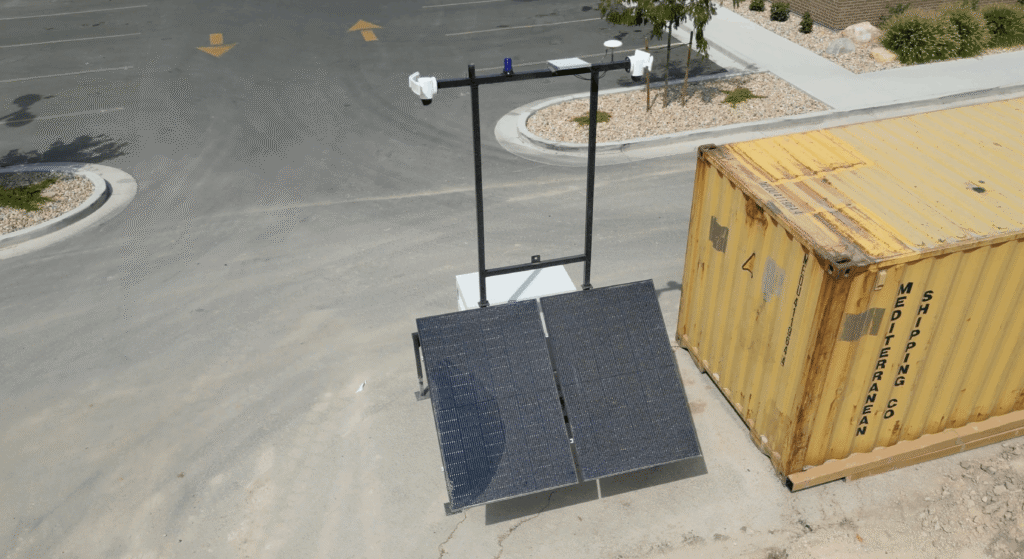
SunRoad’s mobile surveillance trailers are designed to address each of the risk factors that construction site theft statistics consistently identify. Each unit is solar-powered for off-grid deployment, includes AI-enabled cameras with facial recognition and vehicle detection, operates on a scheduled alarm system with motion-triggered lights and a 105-decibel siren, and sends real-time alerts to your phone when unauthorized access is detected after hours.
Units can be repositioned anywhere on your site as your project evolves — keeping active coverage on wherever your highest-value equipment and materials are staged at any given time.
Starting at $799 on a month-to-month rental with no annual contract, SunRoad is designed for the project-based reality of construction — protection for as long as you need it, and the flexibility to cancel when the job is done.
→ Learn more: construction site surveillance cameras
→ View pricing: sunroadsurveillance.com/pricing/
→ Schedule a free demo: sunroadsurveillance.com/schedule-a-demo/
Sources
- National Equipment Register (NER) — annual construction equipment theft loss estimates
- National Insurance Crime Bureau (NICB) — annual theft incident counts
- CONEXPO-CON/AGG (2023) — equipment theft frequency data
- Engineering News-Record — construction site theft impact analysis
- BauWatch 2024 Construction Crime Index — worker theft witness data
- U.S. Department of Energy via Contimod — copper theft statistics
- Deep Sentinel — construction site theft recovery rate data
- WCCTV — construction site theft statistics and state analysis
- Gitnux (2025) — aggregated construction theft statistics