Securing Albuquerque Jobsites and Yards: Why Mobile Surveillance Is Replacing Guards and Fences Alone
Albuquerque contractors don’t need statistics to know their sites are targets — most can point to the missing generator, the stripped wire spools, or the fuel that vanished over a weekend. The Duke City’s mix of sustained property-crime pressure, sprawling low-density development, and jobsites that sit dark and empty from quitting time to sunrise creates exactly the conditions opportunistic theft thrives in. The encouraging news: those same conditions are what modern mobile surveillance was built for, and the economics now favor it decisively over the traditional answers.
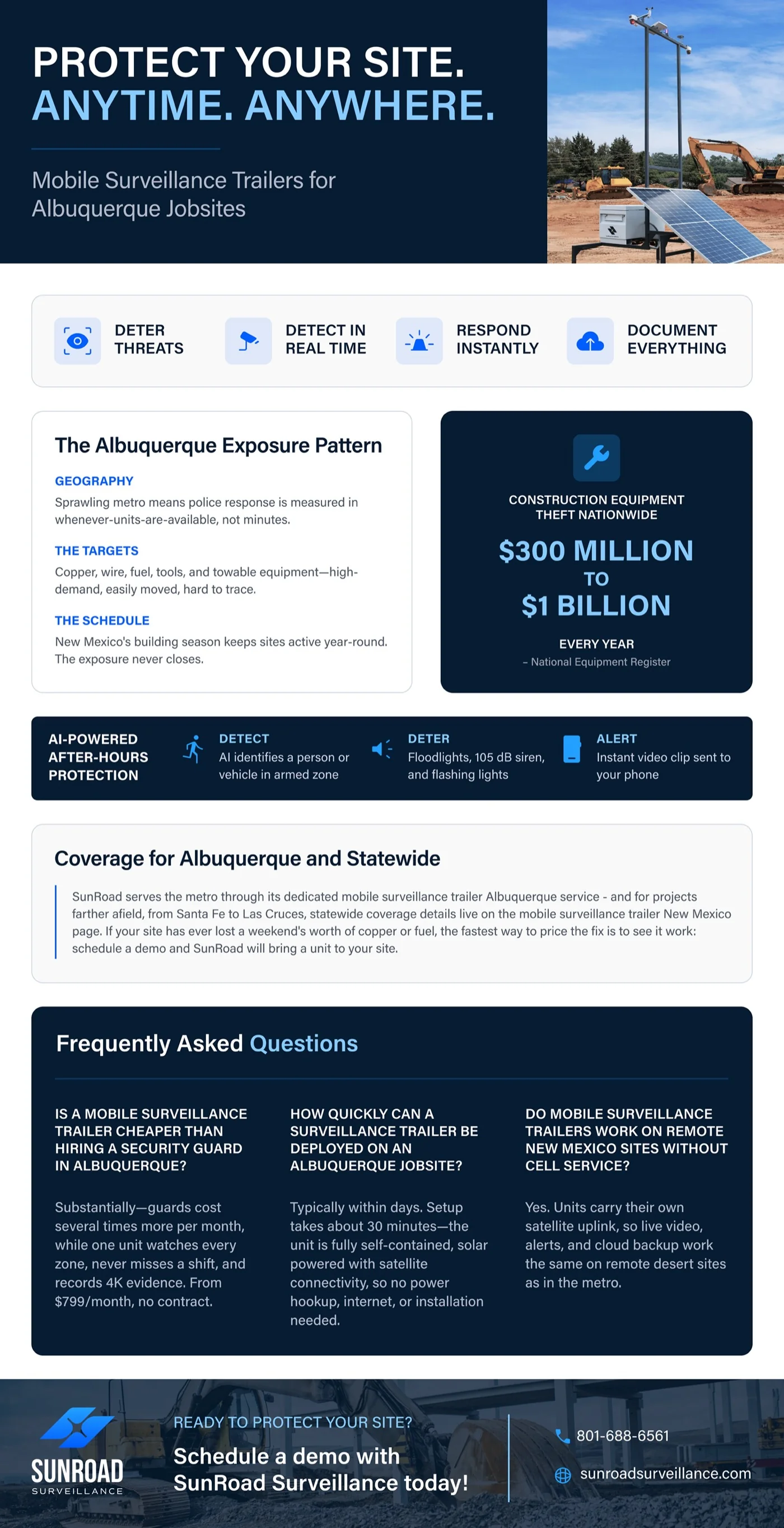
The Albuquerque Exposure Pattern
Three local realities shape jobsite risk here. First, geography: metro Albuquerque spreads across a huge footprint, from Westside subdivisions to North I-25 commercial corridors to industrial projects along the river, so police response to a property call on an empty site is measured in whenever-units-are-available, not minutes. Second, the targets: copper and wire, fuel, hand tools, and towable equipment — all high-demand, easily moved, and hard to trace, which is why the National Equipment Register pegs construction equipment theft at $300 million to $1 billion a year nationally with most of it never recovered. Third, the schedule: New Mexico’s building season keeps sites active most of the year, meaning the exposure never really closes, it just changes hours.
Fencing and padlocks address none of this seriously. Chain link slows a determined visitor by about a minute, and a lock certifies that a theft was a theft — it doesn’t prevent one. What changes outcomes is a site that visibly watches back.
What a Watching Site Looks Like
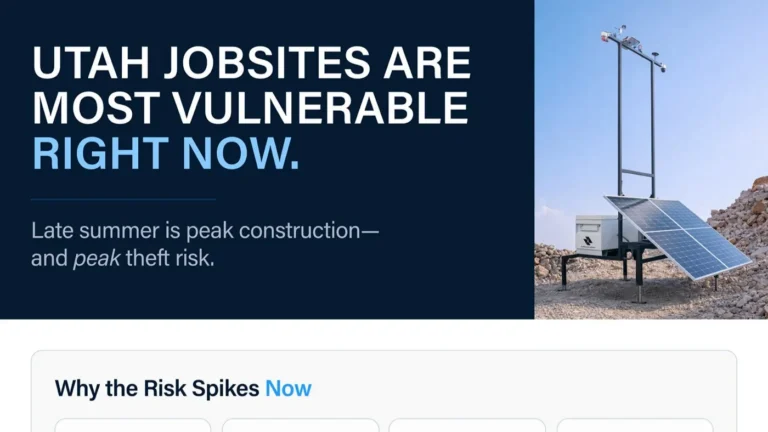
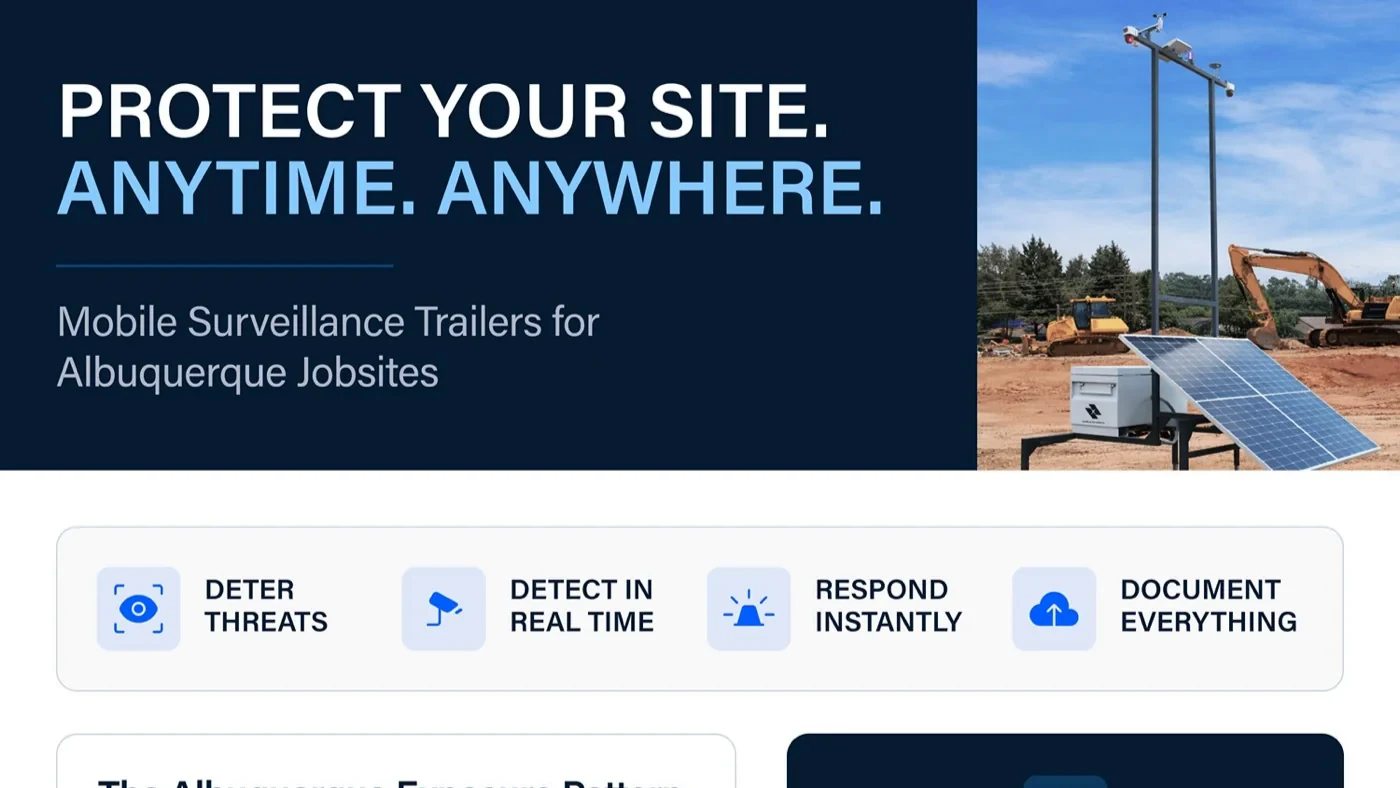
A mobile surveillance trailer parks inside the fence line with a telescoping mast carrying 4K cameras — fixed and 360-degree PTZ — solar panels, batteries, and its own satellite uplink. From one position it covers an area the size of a football field, sees over stacked material, and needs nothing from the site: no power hookup, no internet, no trenching, nothing to install. Delivery to a metro Albuquerque site takes a scheduled visit and setup runs about 30 minutes, which means a project can go from exposed to covered inside a single workday.
After hours, AI detection does the watching. A person or vehicle entering an armed zone triggers the response chain — floodlights, a 105 dB siren, flashing red and blue alarm lights, and an instant clip to your phone — while a tumbleweed, a stray dog, or traffic on the frontage road triggers nothing. That signal-versus-noise discipline is what makes 2 a.m. alerts worth acting on, and it’s the practical difference between AI detection and the motion sensors that cried wolf until everyone stopped listening.
Evidence That Holds Up
When prevention fails, evidence quality decides what happens next. APD property-crime cases live or die on identification, and the difference between “a white truck, maybe a Ford” and 4K footage of the vehicle, the faces, and the timestamped sequence of the loading is the difference between a case number and a case. Cloud backup means the footage survives even if the site — or the unit — is tampered with, and app-based export puts the clip in a detective’s inbox the same morning. That evidentiary weight also does quiet work with insurers, where documented incidents move faster and renew cheaper than mystery losses.
The Guard Comparison Every Estimator Should Run
Overnight guard coverage for a single site costs multiples of a surveillance unit every month, covers one pair of eyes with ordinary human limits, and generates its own management overhead — scheduling, turnover, verification that rounds actually happened. A surveillance unit watches every zone simultaneously, never rotates off shift, records everything it sees, and documents incidents in 4K with timestamps that hold up for police reports and insurance claims. Pricing starts at $799 per month on month-to-month terms with no long-term contract, which for most Albuquerque projects lands well under half the cost of staffed overnight coverage — and the unit shows up for every shift.
Guards still have a place on sites with daytime public interface or complex access control. But for the core Albuquerque problem — empty sites, long dark hours, vehicle-borne theft — the trailer wins on coverage, consistency, evidence quality, and cost, all at once.
Beyond Theft: What Local Crews Actually Use It For
Once a unit is on site, Albuquerque teams tend to discover the operational half of the product. Live view answers did-the-delivery-arrive without a drive across town. Timestamped footage settles disputes with subs about when work happened. The on-board weather station gives site-specific wind and temperature for crane picks and concrete pours in a metro where conditions differ noticeably between the valley and the heights. And on remote or early-phase sites, the unit’s broadcast WiFi keeps crews and devices connected before any utility does.
Coverage for Albuquerque and Statewide
SunRoad serves the metro through its dedicated mobile surveillance trailer Albuquerque service — and for projects farther afield, from Santa Fe to Las Cruces, statewide coverage details live on the mobile surveillance trailer New Mexico page. If your site has ever lost a weekend’s worth of copper or fuel, the fastest way to price the fix is to see it work: schedule a demo and SunRoad will bring a unit to your site.
Frequently Asked Questions
Is a mobile surveillance trailer cheaper than hiring a security guard in Albuquerque?
Substantially, in most cases. Overnight staffed coverage for one site typically costs several times more per month than a surveillance unit, while the unit watches every zone at once, never misses a shift, and records 4K evidence. Pricing starts at $799 per month with no long-term contract.
How quickly can a surveillance trailer be deployed on an Albuquerque jobsite?
Typically within days. SunRoad schedules delivery to metro Albuquerque sites, and setup takes about 30 minutes since the unit is fully self-contained — solar powered with its own satellite connectivity, requiring no power hookup, internet service, or installation work on your site.
Do mobile surveillance trailers work on remote New Mexico sites without cell service?
Yes. Units carry their own satellite uplink, which works anywhere with open sky, so live video, instant alerts, and cloud backup function the same on a remote pueblo-area or desert site as they do in the middle of the metro.
Ready to protect your site? Schedule a demo with SunRoad Surveillance today.
→ Schedule your free demo: sunroadsurveillance.com/schedule-a-demo/
Related Content