Jobsite Security in Phoenix: How Mobile Surveillance Trailers Handle 115-Degree Summers
Phoenix builds through conditions that would shut down construction in most of the country — and its security equipment has to do the same. Asphalt hits 160 degrees, electronics bake inside enclosures, monsoon dust storms drop visibility to nothing, and the Valley’s most comfortable working hours for thieves run from midnight to 5 a.m., when overnight lows still hover in the 90s but the streets are empty. Protecting a Phoenix jobsite means deploying equipment engineered for this specific gauntlet, and it’s where a purpose-built mobile surveillance trailer earns its keep.
Phoenix Risk Runs on a Different Clock
Construction theft everywhere favors darkness; in Phoenix, summer flips the whole schedule toward it. Crews pour concrete at 4 a.m. to beat the heat, sites go quiet through the brutal afternoons, and the gap between last worker out and first worker in becomes irregular enough that a passerby can’t tell an odd-hours crew from an odd-hours thief. That ambiguity is cover. Copper wire, tools, and equipment move fast in a metro growing as quickly as the Valley, and a site that looks unmonitored at 2 a.m. — which describes most of them — is a soft target. What cuts through the ambiguity is a system that knows the arming schedule, challenges what shouldn’t be there, and records everything regardless of hour.
Heat Is the Real Equipment Test
Consumer cameras fail in Phoenix summers for boring reasons: batteries degrade, plastic housings warp, sensors overheat and shut down. A professional mobile surveillance trailer is built around thermal reality — weatherproofed, heat-rated hardware, ventilated enclosures, and components specified for sustained triple-digit operation, not just a survivable peak. The engineering question to ask any vendor isn’t whether their unit works in heat, but what its uptime looked like last July. Units that summer in the Sonoran Desert either have an answer or an excuse.
Dust is the second test. Monsoon season coats lenses and clogs cheap enclosures, so sealed housings and remote health monitoring matter: when a provider watches unit performance from their side, a degraded camera gets caught and serviced before it becomes a blind spot you discover after an incident. Ask how lens cleaning and dust-related service are handled in the rate — in the Valley, that is a when question, not an if question.
The Sun Problem Is Actually a Sun Advantage
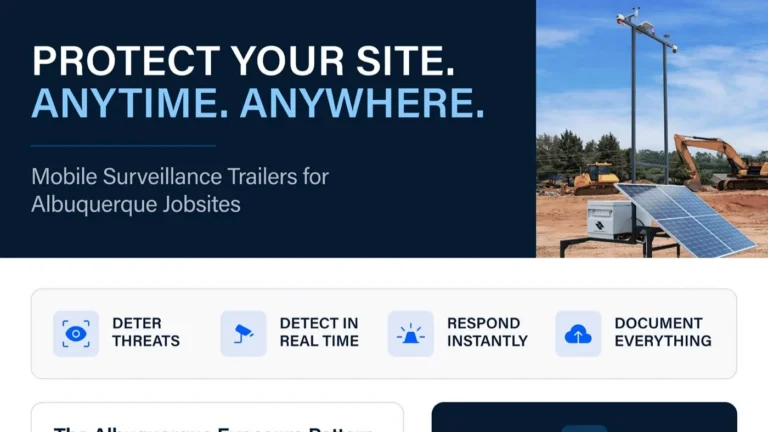
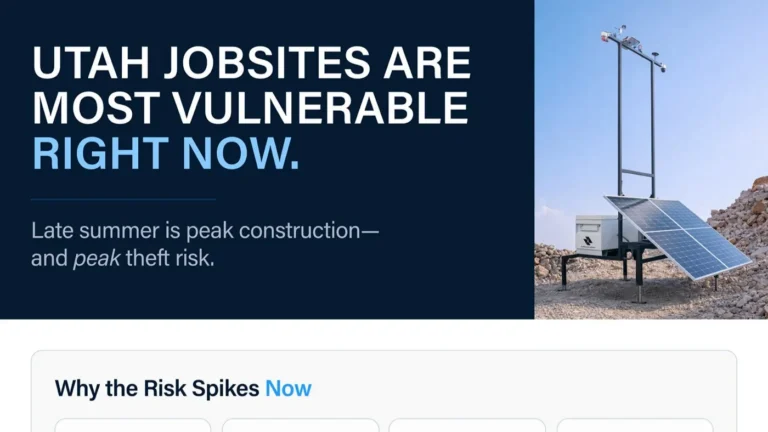
Here’s the elegant part: the same sun that makes Phoenix brutal makes it the best solar security market in the country. Photovoltaic panels convert sunlight directly into electricity — the U.S. Department of Energy’s solar technology primer explains the mechanism — and Phoenix delivers roughly 300 sunny days a year to power them. A solar-plus-battery trailer in the Valley banks a deep energy surplus almost every single day, running cameras, floodlights, sirens, and connectivity around the clock with no generator, no fuel runs, no grid hookup, and no downtime while temporary power gets installed. The battery reserve that carries a Utah unit through inversion weeks mostly just sits comfortable in Phoenix.
Connectivity rides the same independence: satellite-linked units stream live video and push instant alerts from anywhere in the metro — infill sites in Tempe, new subdivisions on the far West Valley fringe, industrial projects out past the loop — without caring whether cell coverage is strong.
Monsoon Season and the Mild Months
Phoenix security isn’t only a summer story. Monsoon storms knock out temporary power and cell service exactly when sites are most likely to be left in disarray — materials uncovered, equipment staged in the open — and a self-powered, satellite-linked unit keeps watching through the outage that blinds grid-dependent systems. Then the mild months bring their own pattern: the Valley’s construction pace surges from October through April, more projects means more targets, and the earlier winter sunsets extend the after-hours exposure window. A unit that rode out July handles all of it without adjustment; the arming schedule just shifts with the season.
What Response Looks Like at 2 A.M. in the Valley
When someone crosses into an armed zone on a Phoenix site, the unit responds in the moment: floodlights fire, a 105 dB siren sounds, red and blue alarm lights flash, and the clip hits your phone in seconds. You watch live, speak through two-way audio, and decide whether to call it in — from bed, from Flagstaff, from anywhere. AI detection separates a person at the fence from a dust gust or a coyote crossing the lot, which in desert conditions is the difference between alerts you act on and alerts you mute. Advanced recognition features, including facial recognition and PPE monitoring, are available on Pro-level plans for sites that want operational intelligence on top of security.
Phoenix Coverage, Delivered This Week
SunRoad delivers across the Valley — see the dedicated mobile surveillance trailer Phoenix page for local details, or the construction site surveillance cameras Phoenix page if your projects are construction-specific. Pricing starts at $799 per month with no long-term contract, setup takes about 30 minutes, and the desert sun handles the power bill. Schedule a demo and watch a unit handle a Phoenix afternoon on your own site.
Frequently Asked Questions
Do mobile surveillance trailers work in Phoenix summer heat?
Purpose-built units do — they use heat-rated, weatherproofed hardware and sealed, ventilated enclosures specified for sustained triple-digit operation, and providers monitor unit health remotely so any heat- or dust-related degradation is serviced before it creates a coverage gap.
Is solar power reliable enough to run security cameras in Arizona?
Arizona is arguably the best solar security market in the country. With roughly 300 sunny days a year, a solar-plus-battery trailer banks a daily energy surplus that runs cameras, floodlights, sirens, and satellite connectivity 24/7 with no generator or grid hookup.
How fast can I get a surveillance trailer on a Phoenix jobsite?
SunRoad delivers across the Phoenix metro and sets up in about 30 minutes, with delivery and setup fees that vary by location. Pricing starts at $799 per month on month-to-month terms, so coverage can typically start within days rather than weeks.
Ready to protect your site? Schedule a demo with SunRoad Surveillance today.
→ Schedule your free demo: sunroadsurveillance.com/schedule-a-demo/
Related Content