Construction Site Theft in Utah: What Project Managers Need to Know

Utah is one of the fastest-growing construction states in the country. According to the Kem C. Gardner Policy Institute at the University of Utah, Utah issued permits for over 21,900 residential units in 2024 alone — a figure that doesn’t include the commercial, tech campus, and infrastructure construction driving development across the Wasatch Front, Silicon Slopes, Washington County, and Cache Valley. More active construction sites means more high-value equipment and materials staged across the state — and more exposure to a problem that costs the U.S. construction industry hundreds of millions of dollars every year.
Construction site theft is not a rare event. It is a consistent, predictable cost that affects Utah contractors of every size — from custom home builders on remote Washington County mesa sites to general contractors managing multi-story commercial developments in downtown Salt Lake City. Understanding when it happens, what gets taken, and what actually stops it is the first step toward protecting your projects and your bottom line.
And the most effective tool Utah project managers have found for all three? A mobile surveillance trailer.
The Scale of the Problem: What the Data Says
The National Insurance Crime Bureau (NICB) and the National Equipment Register estimate that construction site theft costs the U.S. industry between $300 million and $1 billion annually. More than 11,000 equipment theft incidents are reported each year — and industry estimates suggest that figure represents only a fraction of actual incidents, with roughly 85% of construction site theft going unreported to law enforcement or insurers.
| $300M – $1B in annual U.S. construction site theft losses — plus significant indirect costs from project delaysSource: National Insurance Crime Bureau (NICB) / National Equipment Register |
The average single equipment theft incident costs approximately $30,000 in direct losses. But the real number is typically much higher when you factor in the indirect costs that compound after every theft: project delay costs averaging $10,000 per day, emergency equipment rental at inflated rates, the administrative burden of insurance claims and police reports, and the premium increases that follow repeated incidents. A single significant theft on a Utah construction site can easily cost $60,000 to $90,000 in total impact — before the replacement equipment has even arrived on site.
Recovery rates make the math even bleaker. Less than 25% of stolen construction equipment is ever recovered — compared to roughly 60% for stolen passenger vehicles. The structural reason is simple: most construction equipment lacks the built-in GPS tracking and standardized identification systems that make passenger vehicles traceable. Once equipment leaves a Utah construction site, it is almost certainly gone for good.
| Less than 25% of stolen construction equipment is ever recoveredSource: National Equipment Register / WCCTV |
What Gets Stolen — and Why Utah Sites Are Targeted
Utah’s construction environment creates specific theft vulnerabilities. The state’s rapid growth means more active sites at earlier phases of development — exactly when security infrastructure is least established and materials are most exposed. Silicon Slopes’ dense commercial construction corridor creates high concentrations of valuable equipment and materials along the I-15 and Bangerter corridors, which also function as fast-exit routes for organized theft operations. And Utah’s significant volume of remote custom home and subdivision construction — in Washington County, Cache Valley, and on the Wasatch foothill benches — creates isolated sites that are far from emergency response and invisible to any natural surveillance.
The most commonly stolen items from Utah construction sites mirror the national pattern:
- Power tools: the highest-volume theft category, accounting for approximately 41% of all incidents. Portable, valuable, and untraceable.
- Copper wire and HVAC components: the U.S. Department of Energy estimates over $1 billion in copper theft annually, with construction sites among the primary targets. Utah’s active commercial and residential construction creates significant copper exposure.
- Heavy equipment: excavators, skid steers, loaders, and generators. High-value and — without GPS tracking — effectively untraceable once moved.
- Small equipment and hand tools: generators, compressors, and hand tools are frequent targets because they’re easy to move quickly.
- Lumber and steel: material costs remain elevated following supply chain disruptions, increasing the resale value and theft incentive for staged materials.
Insider theft compounds the picture further. Industry data consistently places approximately 50% of construction site theft as involving internal personnel — workers, subcontractors, or vendors with legitimate site access. This is particularly relevant for Utah’s larger commercial projects, where dozens of subcontracting companies may have overlapping site access across an extended project timeline.
When Theft Happens — and Why After Hours Is the Critical Window
Construction site theft follows a consistent and predictable pattern. Approximately 70% of incidents occur overnight — when sites are unmonitored and the risk of being observed is minimal. Weekend theft is particularly common, especially over long holiday weekends when Utah sites may be unattended for three or more consecutive days. The National Equipment Register has documented repeated theft spikes around Memorial Day, Labor Day, and Thanksgiving.
August is historically the peak theft month — coinciding with Utah’s peak construction season when the highest concentration of high-value equipment and materials is staged across the most active sites. For Utah project managers, the theft risk is highest precisely when their sites are most active and most valuable.
Remote and rural Utah sites face a compounding risk factor: response time. A construction site theft Utah on a remote Washington County mesa or a Cache Valley agricultural land development may not be discovered until Monday morning — hours or days after the incident occurred, and long after any recovery window has closed.
Why a Mobile Surveillance Trailer Is the Most Effective Utah Solution
Fixed security cameras, perimeter fencing, and security guards all have documented limitations for construction site applications. Fixed cameras require permanent installation and a power source — both impractical on most Utah construction sites, particularly at early project phases and remote locations. Perimeter fencing provides a barrier but no active deterrence or notification. Security guards are expensive, have coverage gaps, and cannot be in multiple locations simultaneously.
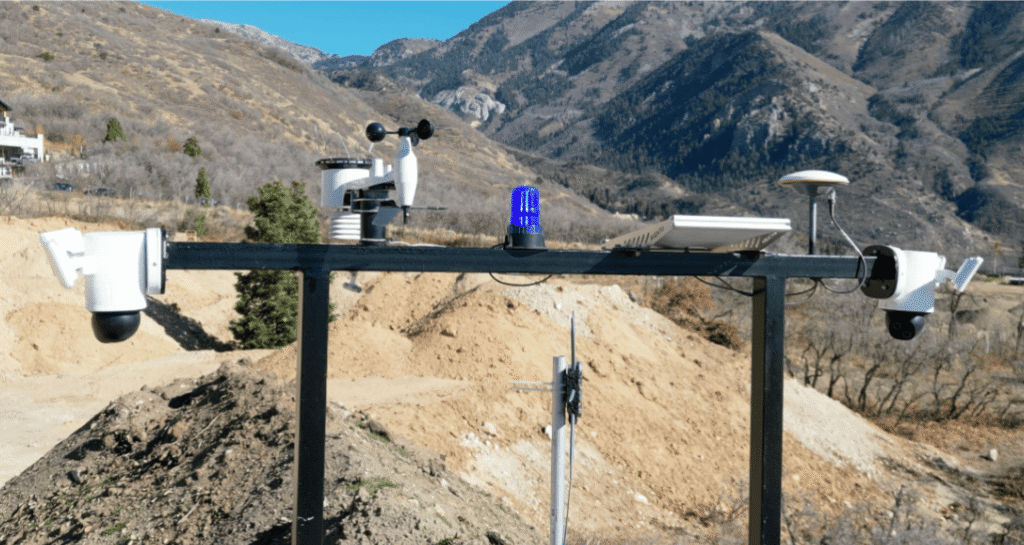
A mobile surveillance trailer addresses all three limitations for Utah job site security. Solar-powered with no installation requirements, it deploys in 30 minutes anywhere in Utah — including remote Washington County desert sites, Cache Valley agricultural locations, and Wasatch foothill custom home builds that have no utility infrastructure. It provides active deterrence — not just passive recording — through motion-activated floodlights, a 105-decibel siren, and red and blue alarm lights that make it immediately clear the site is being actively monitored. And it sends instant push notification with recorded footage to the project manager’s phone the moment motion is detected during alarm hours — enabling a real-time response rather than a Monday morning discovery.
The deterrence data is consistent: sites with visible surveillance are 42% less likely to experience theft than unmonitored sites. The visible presence of a unit that is obviously active — cameras tracking movement, lights ready to activate, an alarm clearly in place — changes the risk calculation for anyone considering the site as a target.
Beyond Security: What a Surveillance Trailer Does During the Day
For Utah project managers, the value of a mobile surveillance trailer goes well beyond after-hours construction theft prevention. The same unit that protects your site overnight becomes an operational management tool during the day. Live camera feeds accessible from the app let you see who showed up and when — every subcontractor arrival is timestamped and logged. Vehicle detection records every delivery truck and material arrival automatically. And for Utah’s custom home builders, sharing live camera access with clients through the app has become a significant service differentiator — clients watch their home take shape in real time, from anywhere in the world.
On Pro and Enterprise plans, AI-powered cameras with advanced capabilities expand the operational picture further: facial recognition, license plate recognition, hard hat and safety vest detection for OSHA compliance monitoring, and a natural language search capability that lets you pull any record from the footage archive instantly. See our full AI features page for a complete breakdown of what’s available at each plan level.
Utah’s Active Markets and Where Theft Risk Is Highest
Not all Utah construction markets carry equal theft exposure. Understanding the specific risk profile of your construction area helps prioritize surveillance coverage:
- Salt Lake City: Urban theft risk from pedestrian access to public-facing sites. Downtown revitalization projects face both theft and trespassing pressure.
- Silicon Slopes / Lehi: I-15 corridor creates fast-exit routes for organized theft operations. High concentration of high-value equipment on simultaneous commercial sites.
- Ogden and northern Utah: I-84/I-15 intersection is a well-documented theft corridor for northern Utah. Remote industrial and suburban sites have limited natural surveillance.
- St. George and Washington County: Remote desert custom home sites are among Utah’s most isolated — and most vulnerable — construction environments.
- Cache Valley / Logan: Rural agricultural land developments face the longest law enforcement response times in Utah’s active construction markets.
For a complete breakdown of SunRoad’s mobile surveillance trailer service across Utah, see our statewide overview page. Or explore construction site surveillance cameras in Utah for the full three-pillar approach to construction site security.
Sources
Related Content