How to Choose a Construction Site Security Camera System in Utah

If you’re a Utah project manager researching construction site surveillance cameras, you’ve quickly discovered that the options are wide — and the differences between them are significant. Fixed cameras versus mobile units. Solar power versus wired power. Basic recording versus AI-enabled analytics. Annual contracts versus month-to-month. And a price range that stretches from a few hundred dollars to several thousand dollars per month.
The right system for a Silicon Slopes tech campus build is different from the right system for a remote custom home site in Washington County. The right system for a downtown Salt Lake City mixed-use development is different from the right system for a Cache Valley subdivision pushing into agricultural land. Utah’s diverse construction environments — from urban infill to remote desert — demand a security camera system that is genuinely built for the job.
This guide walks through the five decisions that matter most when evaluating construction site surveillance cameras for a Utah project — so you can make the right call for your specific site, budget, and project timeline.
Decision 1 — Solar vs. Wired Power
For most Utah construction sites, this decision is straightforward: solar wins.
Wired construction site security cameras require a permanent power source — which means your site needs to have utility power connected before cameras can go up. On most construction projects, that happens well into the project timeline. Foundation work, framing, and the early phases where materials and equipment are most exposed to theft happen before utility power is available.
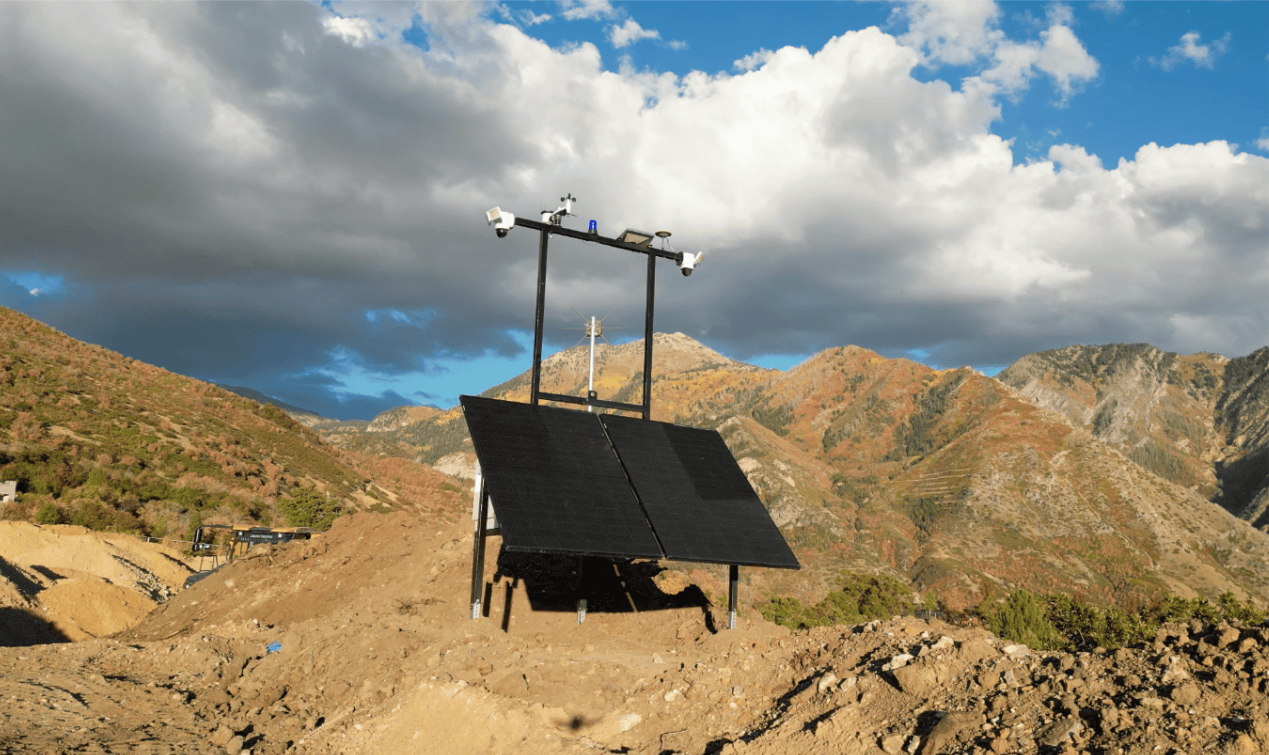
Solar-powered construction security cameras Utah eliminate this constraint entirely. They operate from day one of construction — before a single utility connection has been made — and they work at remote Utah sites where utility power may never be available during the construction phase. Washington County desert custom home sites, Cache Valley agricultural land developments, and Wasatch foothill builds all share this characteristic: construction begins before infrastructure catches up.
Utah’s climate further favors solar. The state averages over 222 sunny days per year statewide, with southern Utah — particularly the St. George and Washington County area — exceeding 300 sunny days annually. This means solar-powered construction site cameras in Utah operate at or near peak efficiency for the majority of the construction season, with battery backup providing continuous operation through winter low-sun periods.
SunRoad’s mobile surveillance trailers are 100% solar powered with battery backup — operational anywhere in Utah, at any phase of a project, without any utility hookup.
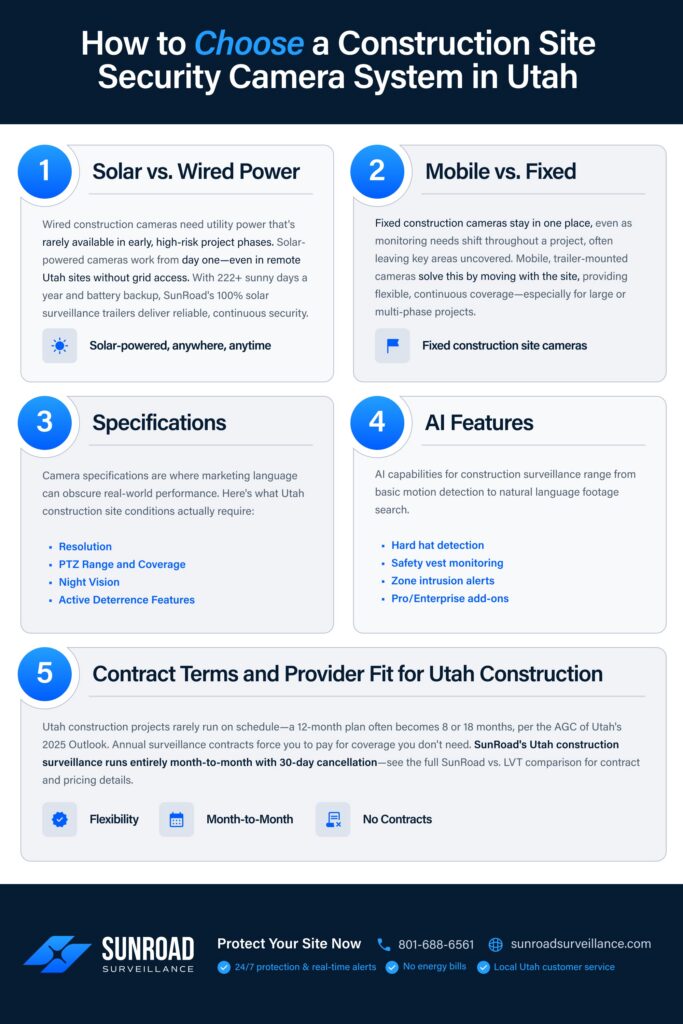
Decision 2 — Mobile vs. Fixed Construction Site Cameras
Fixed construction site security cameras are permanently installed at specific locations — perimeter corners, site entries, or equipment staging areas. Once installed, they don’t move. This creates a fundamental problem for construction: the most critical monitoring location on your site changes as the project evolves.
During excavation and foundation work, the priority is equipment staging and perimeter access. During framing, the coverage need shifts to the active building area and material deliveries. During exterior work, perimeter coverage of exposed materials becomes the priority again. A fixed camera system installed at project start is covering the wrong area for most of the project’s duration.
A construction site security camera Utah — mounted on repositionable trailers — solves this problem by moving with the project. As your Utah construction site’s coverage needs change, the unit repositions to match. No reinstallation. No service call. No coverage gap during transitions.
The mobility advantage is particularly significant for Utah’s larger projects — residential subdivisions where the active construction front moves across the site over months, or commercial campus builds in Lehi and the Silicon Slopes corridor where framing, exterior, and interior work happen simultaneously in different areas of the site.
Decision 3 — What Camera Specifications Actually Matter
Camera specifications are where marketing language can obscure real-world performance. Here’s what Utah construction site conditions actually require:
Resolution
4K resolution is the practical minimum for construction site surveillance cameras that will be used for evidence documentation. At lower resolutions, facial identification and license plate recognition become unreliable — particularly at the distances required to cover a full construction site perimeter. SunRoad’s 4K cameras deliver clear, evidence-quality footage day and night.
PTZ Range and Coverage
PTZ (pan-tilt-zoom) cameras with sufficient range are essential for covering Utah’s larger construction sites from a single unit. SunRoad’s PTZ cameras provide 328-foot range with 360-degree view — covering the full perimeter of most construction sites without requiring multiple fixed camera installations. The combination of a fixed bullet camera and PTZ camera on each Standard unit provides both wide perimeter coverage and precision tracking capability in a single deployment.
Night Vision
Given that approximately 70% of construction site theft occurs at night, night vision is not optional — it’s the primary operating environment. All SunRoad cameras include night vision capability. The AI-powered detection that identifies motion, vehicles, and people during the day continues operating in complete darkness — ensuring that after-hours detection quality matches daytime monitoring.
Active Deterrence Features
Recording what happens is not the same as preventing it. Effective construction site security cameras include active deterrence features: motion-activated floodlights, a loud siren (SunRoad’s units use a 105-decibel siren), and visible alarm indicators. Red and blue alarm lights signal active monitoring. These features change the experience of approaching a monitored construction site from low-risk to high-risk — which is the actual deterrence mechanism.
Decision 4 — AI Features: What You Actually Need
AI capabilities for construction site surveillance cameras range from basic motion detection to sophisticated natural language footage search. Understanding which capabilities are genuinely useful for construction — and which are enterprise features designed for other industries — helps Utah project managers invest in the right plan.
According to OSHA’s construction safety standards, employers are required to provide and enforce the use of appropriate PPE — including hard hats and safety vests — on construction sites. The enforcement burden typically falls on supervisors and safety officers. AI-powered PPE monitoring changes this, and can be set for weekly reports, or whatever is needed by the company.
- Hard hat detection: identifies workers without required hard hats in designated areas, in real time
- Safety vest monitoring: flags workers without high-visibility vests across all active site zones
- Zone intrusion alerts: detects unauthorized access to restricted areas automatically
For Utah project managers who want full operational intelligence from their construction site cameras, Pro and Enterprise plans unlock the complete AI suite: facial recognition for worker accountability, vehicle detection for delivery logging, license plate recognition, firearm detection, and smoke and fire detection. The app’s natural language search lets you query footage directly — search ‘white pickup trucks on Tuesday’ or ‘workers without safety vests near the excavation’ and the system surfaces every matching clip.
Explore the full breakdown of AI capabilities by plan level to understand which features are available on Standard vs. Pro vs. Enterprise plans.
Decision 5 — Contract Terms and Provider Fit for Utah Construction
The Associated General Contractors of Utah’s 2025 Construction Outlook consistently highlights the project-based, variable-timeline reality of Utah’s construction industry — projects that were planned for 12 months frequently run 8 or 18, and the flexibility to scale security resources up or down with project activity is a genuine operational need.
Annual contracts for construction site security cameras create a fundamental mismatch with how Utah construction actually works. A nine-month commercial project locked into a 12-month surveillance contract is paying for three months of coverage on a completed, empty site. Month-to-month rental agreements eliminate this problem — you have coverage for exactly as long as your project needs it, and you can cancel with 30 days written notice when the work is done.
SunRoad operates entirely on month-to-month agreements with no annual contract for construction site video surveillance Utah. See a full comparison of SunRoad vs. LVT — including contract terms, pricing, and features — for a direct evaluation of what Utah construction companies are choosing between.
Matching the Right Plan to Your Utah Construction Site
Once you’ve decided on solar, mobile, 4K, and month-to-month — the remaining choice is which plan level fits your site’s specific requirements:
- Standard ($799/month): 4K cameras with powerful floodlights and AI-powered detection, fixed bullet and PTZ camera combination (328-foot range, 360-degree view), AI search in app for core detection features, on-site WiFi, weather station. Ideal for smaller Utah residential and early-commercial projects.
- Pro ($999/month): All Standard features plus NDAA-compliant cameras with the full advanced AI suite, 8x video storage, remote monitoring, and full natural language AI search. Ideal for larger Utah commercial projects, multi-subcontractor environments, and sites with OSHA compliance documentation requirements.
- Enterprise (contact sales): All Pro features plus additional camera options, custom sensors, and configurations for specific site requirements. Ideal for multi-site Utah construction fleets and institutional clients.
See the full plan comparison and pricing →
The Bottom Line for Utah Project Managers
The right construction site surveillance cameras for a Utah project are solar-powered, mobile, 4K with active deterrence, and available on a month-to-month agreement that matches your project timeline. The AI features you need depend on whether your priority is basic security and operations or full compliance monitoring and fleet-level intelligence.
SunRoad delivers and sets up anywhere in Utah in 30 minutes — from Salt Lake City and the Wasatch Front to St. George and Washington County. Schedule a free demo and we’ll walk you through exactly how the right plan fits your specific Utah construction site.
→ Schedule a Free Demo: sunroadsurveillance.com/schedule-a-demo/
→ Explore All Features: sunroadsurveillance.com/features/
→ View Pricing: sunroadsurveillance.com/pricing/
→ Utah Statewide: Construction site surveillance cameras in Utah →
Sources
SunRoad Surveillance — LVT vs. SunRoad: Which Is Better for Construction Sites?
OSHA — Construction Safety Standards (29 CFR Part 1926)
Associated General Contractors of Utah — 2025 Construction Outlook
Related Content