
Parking lot surveillance that starts working the day it arrives
Most parking lot surveillance projects stall on one question: where does the power come from? The nearest outlet is inside the building, and the pole lights often run on a timer. A camera trailer removes the question. SunRoad tows it in, parks it where you need coverage and has it recording in about 30 minutes, plus about 30 minutes of app training for your team.
Break-ins don't wait for a capital budget. A trailer covers the lot now while you plan the long term with real footage in hand.
What goes wrong in parking lots after dark
Most lot trouble is opportunistic and quick.
- Vehicle break-ins. In the FBI's 2019 Crime in the United States report, thefts from motor vehicles made up 27.1 percent of all larceny-thefts.
- Catalytic converter theft. The National Insurance Crime Bureau (NICB) notes a converter can be removed in just a few minutes, and the platinum, palladium and rhodium inside make it worth stealing.
- Vandalism and loitering in back rows and behind buildings after close.
- Illegal dumping. Mattresses, tires and debris left in empty rows, and the owner pays to haul it.
- Liability claims. Door dings, hit-and-runs and trip-and-fall claims all turn on what actually occurred.
The research backs cameras here. A 2019 meta-analysis by Piza, Welsh, Farrington and Thomas in Criminology & Public Policy, covering 40 years of CCTV studies, found the largest and most consistent effects in car parks. Cameras paired with other measures also outperformed cameras alone. A trailer pairs cameras with lights, a siren and a voice on one unit.
How a parking lot camera trailer works
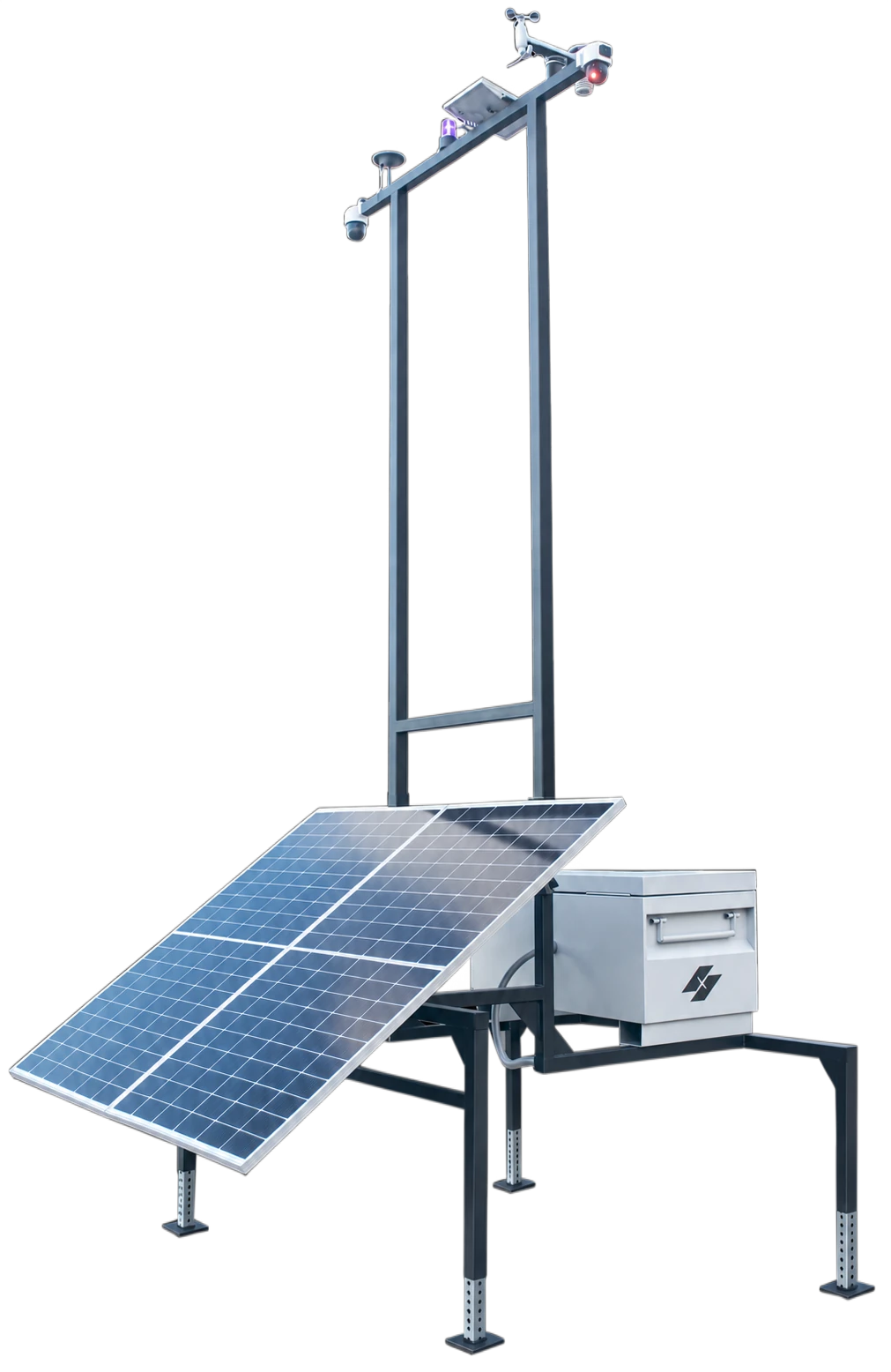
Every SunRoad mobile surveillance trailer carries this kit on every plan:
- A 4K camera with powerful floodlights and AI-powered detection.
- A combined fixed bullet and PTZ camera. The PTZ sees 360 degrees, reaches 328 feet and has 8x total zoom (3x optical).
- Night vision and motion detection.
- Motion-activated floodlights, red and blue alarm lights, a 105 dB siren and two-way audio.
- Starlink satellite internet, 2 TB of on-site storage and cloud backup.
The SunRoad app adds live view, recorded playback, intrusion alerts and AI-powered search (basic on Standard, full on Pro and PRO-X). See how the unit responds to an intrusion.
Parking lot surveillance cameras that need no power or wiring
A permanent camera in the middle of a lot is a construction job: saw-cut the asphalt, trench, pull wire, patch. Mounting on a light pole looks cheaper, but if that circuit runs on a photocell or a timer, the camera can lose power when the lights switch off.
Solar panels with battery backup skip all of it. No utility hookup, no trenching, no wiring, and no lot circuit for a thief to cut first.
Portable parking lot security cameras that move between lots
Plenty of lot problems are temporary, or they move:
- A strip center between tenants, with half the lot empty at night.
- Seasonal overflow parking for holiday retail or a stadium.
- An apartment community hit by a run of break-ins.
Rent month-to-month, keep a unit only as long as the problem lasts, and have SunRoad relocate it when the trouble shifts. Relocation is quoted.
Mobile parking lot security cameras for owners with several sites
Property managers watch each unit from the SunRoad app on their phones. For office parks, warehouses and vacant buildings, see commercial property security. Dealers guarding inventory rows should see car lot security.
Parking lot surveillance towers: what those camera towers do
Surveillance tower, security tower, camera trailer: the names describe one design. Cameras, lights and a siren sit high on a towable base, so one post sees over parked cars. When someone walks into a closed lot:
- Detect. AI-powered detection flags the person, and you can zoom in with the PTZ from your phone.
- Warn. Floodlights and red and blue lights switch on.
- Escalate. The 105 dB siren sounds, and you can talk to the person through two-way audio.
- Record. Video is saved on site and in the cloud, and an alert reaches your phone.
Parking lot security towers work partly by being seen
A tower at the entrance tells every driver the lot is recorded. Late-closing staff don't need camera access to quiet it: with Siren Snooze, an approved team member can mute the siren for a chosen period with a WhatsApp message. It re-arms automatically, and a log records each snooze.
Strip mall security cameras for shopping centers and retail lots
Strip mall security cameras do a different job from a camera over one store's door. In a typical shopping center the parking field is common area, shared by tenants with very different hours. A gym opens at 5 a.m., a restaurant closes at midnight and the dental office is dark by six. The lot is rarely empty, which makes it hard to tell who belongs.
Tenant cameras usually point at their own entrances. The gaps fall between them: the rear service lane with its loading doors and dumpsters, pad sites at the street that close early, and the far rows where employees park. A trailer gives the landlord footage of the common area itself.
A camera trailer vs. an installed parking lot security system
If you own the lot, plan to hold it for years, already have conduit in the right spots and need coverage that won't change, a permanent parking lot security camera system is usually the better long-term buy.
A trailer fits better when:
- You need coverage this week, not after bids, permits and trenching.
- You lease the property or plan to sell or redevelop it.
- You want lights, a siren and a voice, not just recording.
Many owners run both: installed parking lot security systems on the doors and a trailer on the open lot. Also compare a camera trailer with security guards on cost and coverage.
Where to place parking lot security cameras
Placement beats camera count:
- Entrances and exits first. Every vehicle passes them, and every driver sees the unit.
- Look down the rows, not across them. Parked cars block a cross-row view; the drive aisle stays open.
- Cover the dark edges. Back rows, building sides, dumpster enclosures, loading areas.
- Watch for tall vehicles. Box trucks and RVs create blind spots.
- Give the panels open sky. Avoid trees and a building's afternoon shadow.
One unit or several?
One unit can watch roughly a football field of ground; a full field with end zones is about 1.32 acres. Divide your lot's acreage by that for a rough starting count, then adjust for buildings, islands and sight lines. A lot around a big-box store often needs a unit on each side. Get a quote and SunRoad will recommend a count and placement.
SunRoad delivers across Utah, Arizona, Nevada, New Mexico and Colorado.
Get a Quote for Parking Lot Security Cameras
Tell us your lot size, your trouble spots and how soon you need coverage. We will recommend a unit count and placement and quote delivery to your address. Plans start at $999 a month. Want to talk through a lot layout first? Call 801-688-6561.