
Where SunRoad Works in Colorado
Our Colorado service area has three zones:
- The Denver metro: Denver, Adams, Arapahoe, Jefferson, Douglas and Broomfield counties.
- Colorado Springs and El Paso County: the city and the growing ground on its north and east sides.
- The I-25 corridor: Castle Rock, Monument and the interchanges between them.
SunRoad runs mobile surveillance trailer rentals from its base in Utah and delivers to Colorado sites instead of keeping a local office. For metro detail, see security cameras in Denver and construction security in Denver. For every state we serve, see SunRoad locations.
What each unit carries
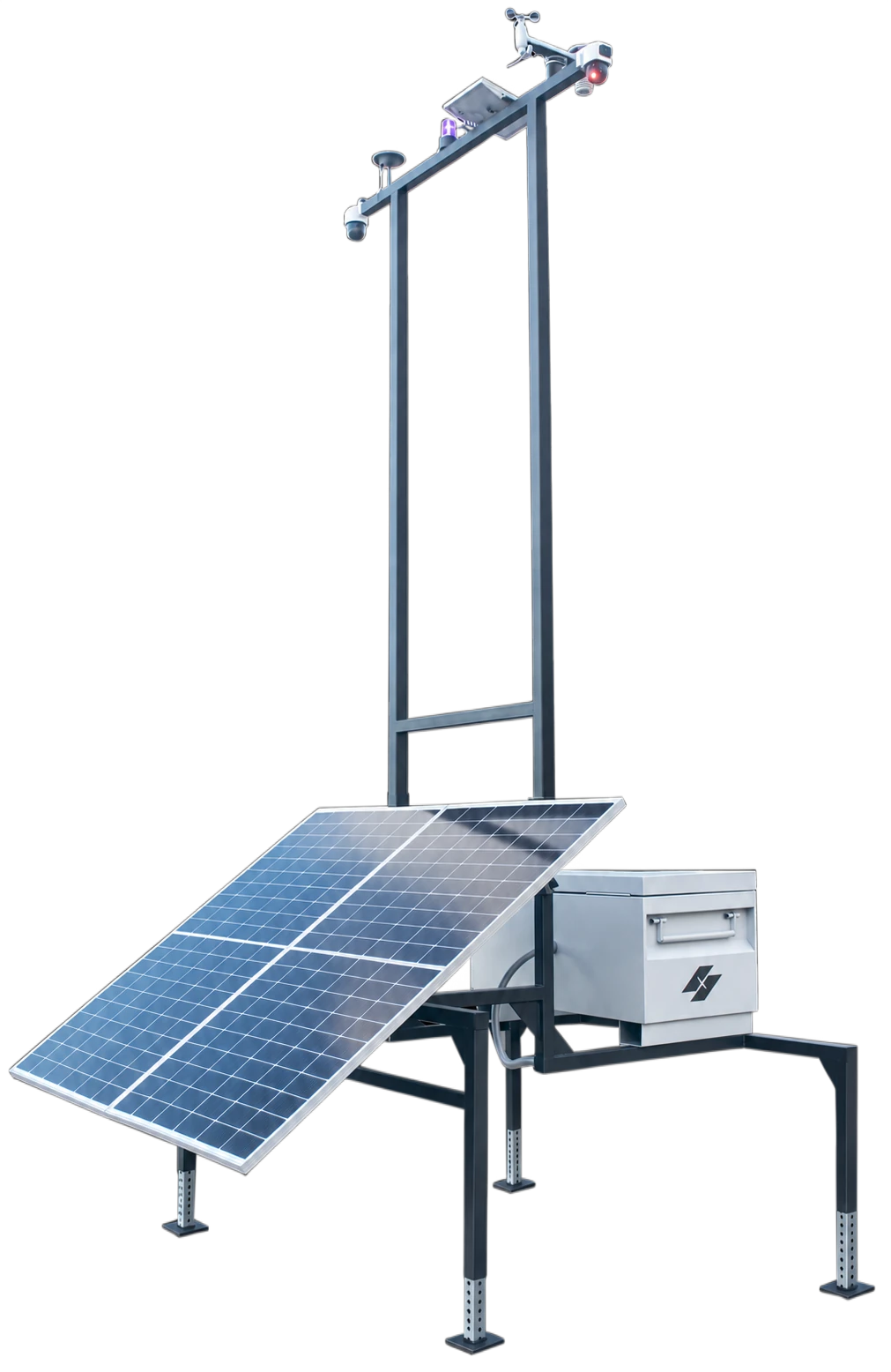
New to the equipment? Here is the short version of a mobile surveillance trailer. The solar-powered surveillance camera system stores energy from its panels in a battery backup and gets online through Starlink. Its first camera shoots 4K with AI-powered detection and floodlights; the second pairs a fixed bullet lens with a PTZ that swings a full circle and sees 328 feet out. Deterrence is built in: a 105 dB siren, red and blue alarm lights, motion-activated floodlights and two-way audio, so you can speak to anyone on site. Video lands on 2 TB of local storage and is backed up to the cloud. A single unit watches about a football field, and its on-site Wi-Fi is open to your crew.
Front Range Weather and What It Means for a Solar Camera Trailer
Buyers looking at mobile surveillance trailer rental in Colorado usually ask about weather first. Here is what each season means for a solar surveillance trailer in Colorado.
Snow, cold and short days
Denver's normal snowfall is 49 inches a year, according to the National Weather Service in Boulder, and the official station hit minus 14 degrees in January 2025. Winter shortens the charging day; when the panels aren't producing, the battery backup takes over. We don't publish runtime figures; storms vary too much. You get visibility instead: the weather station forecasts seven days ahead and alerts you to temperature swings, high wind and rain.
Hail season
Colorado, Nebraska and Wyoming form what meteorologists call Hail Alley, and the Rocky Mountain Insurance Information Association (RMIIA) says the Front Range typically sees three or four catastrophic hailstorms between mid-April and mid-August. No outdoor equipment is hail-proof. A trailer earns its spot another way: it records the storm and the hours after, and you can check the site from your phone before anyone drives out.
Altitude and wind
Denver sits at 5,280 feet, and clear days at that height bring intense sun. Wind is the bigger variable. The Boulder NWS office notes that cold-season windstorms can reach 60 to near 100 mph in and near the foothills, with Denver and Colorado Springs among the areas affected. If your site sits on an exposed ridge, say so when you request a quote.
Colorado Springs and El Paso County
El Paso County has been Colorado's most populous county since the 2010 Census, according to state figures reported by the Denver Gazette. Most new building in Colorado Springs sits on the north and east sides:
- InterQuest and Northgate: the north-end district off I-25 that The Gazette called arguably the city's hottest commercial hub, with Polaris Pointe nearby.
- Powers Boulevard (State Highway 21): the east-side spine from Fountain toward Interquest Parkway, past the Colorado Springs Airport.
- The Woodmen Road corridor: apartments and retail stretching east toward Falcon and subdivisions such as Meridian Ranch.
- Banning Lewis Ranch: the east-side tract the city annexed in 1988, where neighborhoods such as Percheron are planned.
These sites are large and open on several sides: retail pads with long frontage, phased subdivisions where finished homes sit beside open framing, commercial lots off Powers left empty after hours. A self-powered trailer suits them. Hail matters here too. RMIIA lists the July 28, 2016 Colorado Springs storm among the state's costliest, at $352.8 million.
The I-25 Corridor Between Denver and Colorado Springs
I-25 links Colorado's two largest cities. CDOT finished the 18-mile I-25 South Gap project, from south of Castle Rock to Monument, in November 2022, adding an express lane each way, wider shoulders, wildlife crossings and truck climbing lanes near Monument Hill.
The corridor crosses the Palmer Divide, the ridge between the two metros. KOAA meteorologists note that in smaller storms, conditions can differ sharply from one side to the other, and CDOT has pre-treated Monument Hill and warned of possible closures ahead of big snow. Two takeaways:
- Castle Rock and Monument sites can see different weather the same night, so each unit's own alerts beat a metro forecast.
- Corridor sites are often raw ground: pads near interchanges, contractor yards, new subdivisions without utilities. A unit with its own power and Starlink connection fits.
What Colorado Customers Put a Trailer On
Across the Front Range, a mobile surveillance trailer in Colorado usually ends up on one of four kinds of property:
- Construction. Grading, vertical and finish work each carry their own risks; see construction site security cameras.
- Shopping centers and parking lots. Retail, hotel and overflow lots; our page on parking lot security cameras covers entrances and exits.
- Vacant and transitional property. Buildings between tenants or awaiting redevelopment; see commercial property security.
- Dealer and equipment yards. Car lots, RV dealers and contractor yards; see car dealership security.
Bigger operations can move to Pro and PRO-X for NDAA-compliant cameras, remote monitoring, 8x the recording storage and AI tools such as vehicle detection and zone intrusion alerts. Every Colorado plan, Standard included, starts with the same two cameras and deterrence package.
Delivery, Setup and Moving Units Across the Front Range
Here is how SunRoad works:
- Quote. Tell us the site address and the area to cover; we price delivery and setup for that spot.
- Setup. The trailer is positioned and running in about 30 minutes.
- Training. Roughly half an hour on the app, covering live view, recorded playback, intrusion alerts and AI-powered search (Standard gets the basic version; Pro and PRO-X get the full one).
- Moves. When work shifts, say from a Douglas County pad to an El Paso County lot, we relocate the unit for a quoted fee.
Terms are month-to-month with no long-term contract; give 30 days' written notice to end a rental. Plans start at $999 a month, and pricing shows what each plan adds. When you're ready, get a quote for your site.
Price a Mobile Surveillance Trailer Rental in Colorado
The fastest way to price mobile surveillance trailer rental in Colorado is to send us an address and a rough idea of what you want covered. We'll return a plan and a delivery quote. Rather talk to someone first? Call 801-688-6561.