Running Multiple Job Sites Across the Wasatch Front: The Utah Drive-Time Problem
A mobile surveillance trailer lets Utah contractors check every job site from one app instead of driving the I-15 corridor. Live feeds, timestamped subcontractor arrivals, and delivery records from Ogden to Provo replace routine site visits and put drive time back into the workday.
The Wasatch Front Is a Hundred Miles of Job Sites
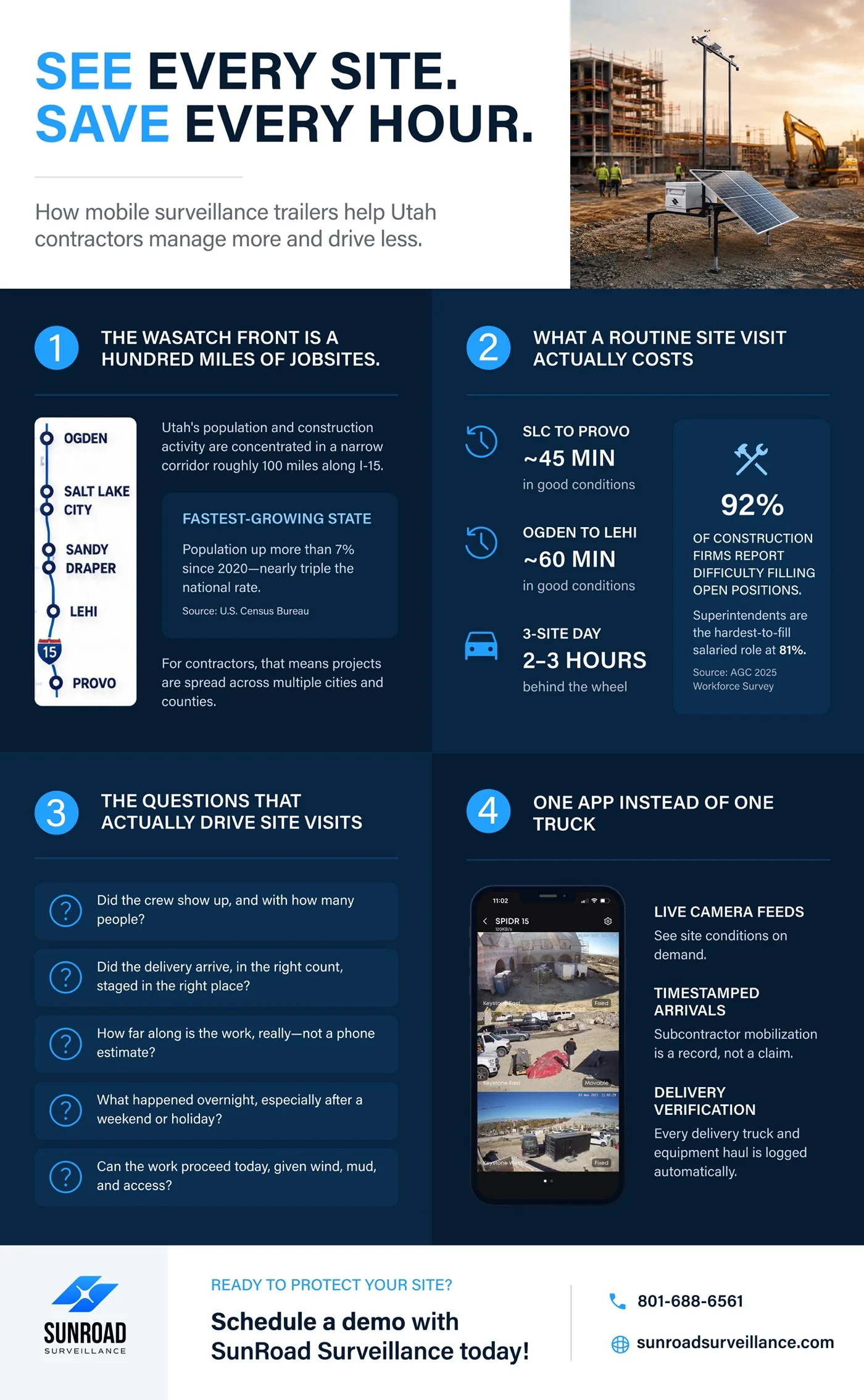
Utah has unusual construction geography. Most of the state’s population and building activity is packed into a narrow strip of valley floor between the Wasatch Range and the Great Salt Lake — roughly a hundred miles from Ogden down through Salt Lake County, Sandy, Draper, and Lehi, ending around Provo and Spanish Fork. U.S. Census Bureau data places Utah among the fastest-growing states in the country, with population up more than seven percent since 2020 — nearly triple the national rate — and nearly all of it lands inside this corridor.
For contractors, that produces a specific operating pattern: even a moderate-size general contractor is rarely working one city. A typical portfolio spans a commercial build in Salt Lake City, residential projects in Utah County, a tenant improvement in Sandy, and something in Davis or Weber County. The work follows the growth, and the growth spans the whole corridor.
The complication: the Wasatch Front is linear, not radial. In a hub-shaped metro, a superintendent loops several sites efficiently. Along I-15, sites are strung end to end, and visiting three often means driving the corridor twice.
What a Routine Site Visit Actually Costs
Most project managers underestimate this cost, because it shows up as time rather than a line item.
Salt Lake City to Provo runs about forty-five minutes in good conditions, and longer during I-15 peaks. Ogden to Lehi is close to an hour. Add the visits themselves, and a three-site day consumes two to three hours behind the wheel before anyone has solved a single problem.
That matters more than it did a decade ago, because experienced field leadership is scarce. The AGC’s 2025 workforce survey found 92 percent of construction firms report difficulty filling open positions, with superintendents the hardest-to-fill salaried role at 81 percent. When that person is in a truck on I-15, they are not running a schedule, resolving a conflict, or coaching a foreman.
Here is the part worth sitting with: most routine site visits are verification trips, not problem-solving trips. Someone drives forty minutes to confirm something that could be confirmed in fifteen seconds if the information were available.
The Questions That Actually Drive Site Visits
Ask a Utah superintendent why they drove to a site on a given day and the answer usually falls into a small, repetitive set. Did the crew show up, and with how many people. Did the delivery arrive, in the right count, staged in the right place. How far along is the work, really — not a phone estimate from someone with an incentive to round up. What happened overnight, especially after a weekend or holiday. And can the work proceed today, given wind, mud, and access, before a crew gets dispatched from another location.
Every one of those is an information question. None of them requires physical presence. They require the information to exist somewhere a project manager can reach it.
One App Instead of One Truck
This is the practical case for putting a monitoring unit on each active site rather than treating it as a security-only purchase: the unit answers those recurring questions continuously, for every site, without anyone driving anywhere.
Live camera feeds show site conditions on demand. Arrivals are timestamped and logged automatically, making subcontractor mobilization a record rather than a claim. Vehicle detection captures every delivery truck and equipment haul entering the property, turning delivery verification into a lookup. And the on-site weather station reports conditions at that specific site — relevant where a canyon, a bench, and the valley floor can differ meaningfully on the same morning.
On Pro-level plans, AI security cameras add natural-language search across the footage archive — query a vehicle, a time window, or an event and get the relevant clips instead of scrubbing video.
The units run on solar power with Starlink satellite connectivity, so they deploy at any project phase — including grading and foundation work, months before utility power reaches the site. Setup takes about thirty minutes with no installation.
What Changes When Every Site Reports In
The shift that contractors describe after running monitored sites across a portfolio is a move from scheduled checking to exception-based management.
Instead of driving a rotation because it is Tuesday, a superintendent reviews every site from the app each morning and drives only to the one that needs attention. Routine verification stops consuming windshield time; the trips that happen have a purpose behind them.
Two secondary effects tend to follow. A single experienced superintendent can credibly cover more sites — which matters when the constraint on growth is hiring rather than demand — and disputes get shorter, because a contested delivery or questioned sub hours gets answered by a timestamped record instead of two competing recollections.
Client communication improves the same way: sharing live access lets an owner check progress on their own schedule instead of calling the project manager for updates.
Scaling Across a Utah Portfolio
Running the same configuration on every active site produces consistency that is hard to get otherwise: the same coverage, logging, and app whether the project is in Ogden, Salt Lake City, Sandy, Lehi, or Provo. Superintendents moving between projects work with one interface rather than whatever was installed on each job.
Month-to-month terms starting at $799 per month keep this workable across a portfolio where projects start and finish on staggered schedules. A unit follows a job to completion and then moves to the next one, so the fleet size tracks the number of active sites rather than a fixed annual commitment.
Statewide details: mobile surveillance trailer Utah rentals. Deployment process: how SunRoad Surveillance works. City coverage: areas we serve.
Stop driving I-15 to answer questions an app can answer. See what running every Utah site from one screen looks like.
→ Schedule your free demo: sunroadsurveillance.com/schedule-a-demo/
Frequently Asked Questions
Can one person monitor several Utah job sites at once?
Yes. All active sites appear in the same app, so a superintendent reviews live feeds, arrival logs, and delivery records across a portfolio in minutes each morning, then drives only to the site that needs attention.
Does the system show which subcontractors arrived and when?
Arrivals are timestamped and logged automatically, and vehicle detection captures delivery trucks and equipment entering the property. On Pro-level plans, facial recognition creates individual-level records and the footage archive supports natural-language search.
How many units would a contractor with five active sites need?
Typically one per active site, since each unit covers a single location. With month-to-month rental starting at $799 per month, units move to new projects as jobs finish, so the fleet tracks active work rather than a fixed commitment.
Can a unit deploy before utility power reaches a Utah site?
Yes. The units are fully solar powered with battery backup and connect over Starlink satellite, so they operate from grading and foundation work through completion without any utility hookup or fixed internet connection.
Related Content