Construction Site Surveillance: A Project Manager’s Guide to Protecting and Managing the Job Site

For most people, the phrase construction site surveillance brings to mind one thing: theft prevention. And while protecting a job site from theft and vandalism is a central function, modern construction site surveillance does far more than watch for intruders after dark. Today’s AI-powered camera systems have become one of the most valuable day-to-day management tools a project manager has — providing visibility, accountability, and documentation that extend well beyond security. This guide explains what construction site surveillance includes, how it works, and how it delivers value across the entire project lifecycle.
What Is Construction Site Surveillance?
Construction site surveillance is the use of cameras and monitoring systems to observe a job site — for both operational management and security. Traditional surveillance was purely reactive: cameras recorded footage that someone might review after an incident. Modern construction site surveillance is proactive and intelligent. AI-enabled cameras don’t just record — they identify people and vehicles, detect safety compliance issues, flag unauthorized access in real time, and make the entire footage archive searchable. The result is a system that protects the site and actively helps manage it.
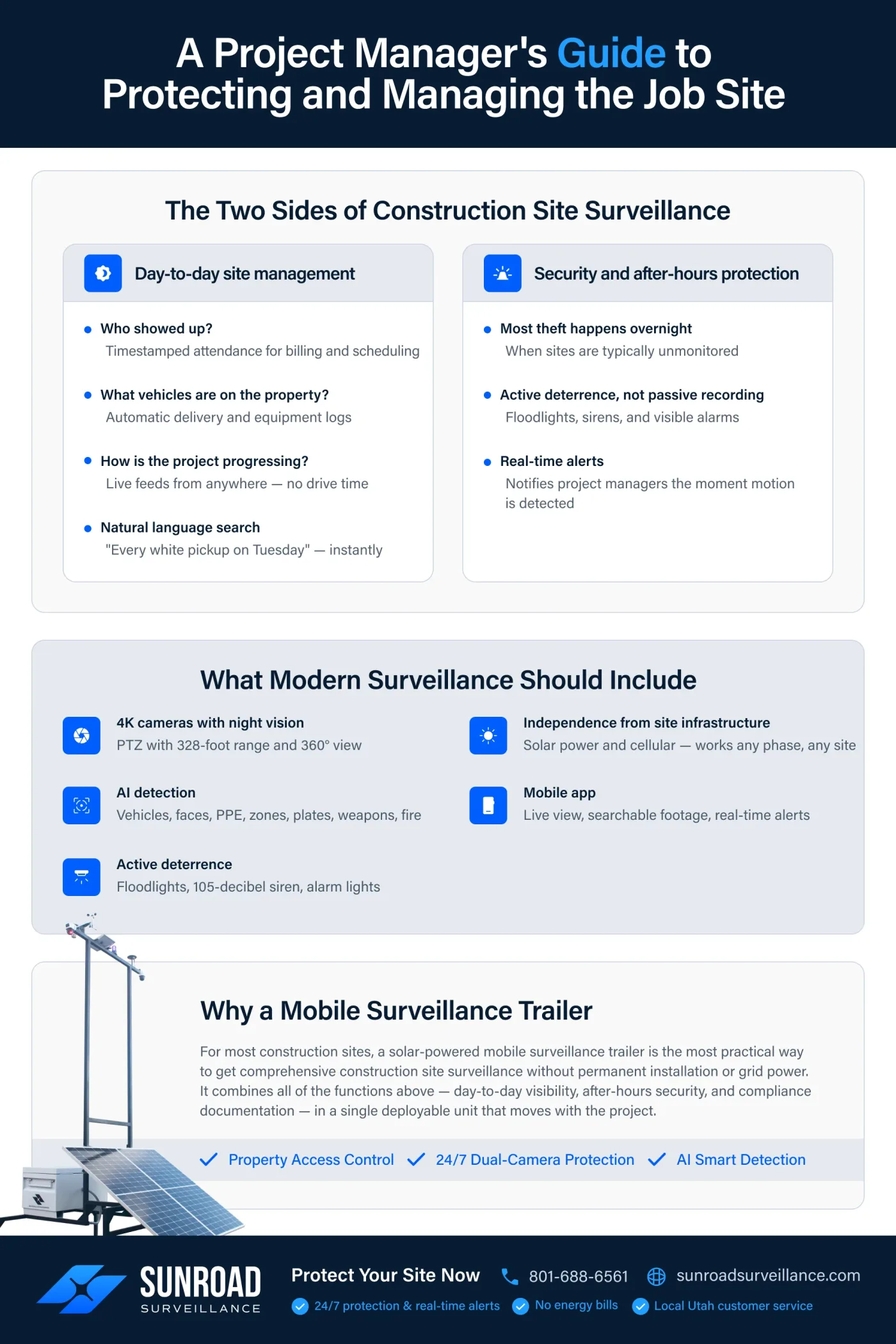
The Two Sides of Construction Site Surveillance
Effective construction site surveillance serves two distinct purposes that together justify the investment.
Side 1 — Day-to-Day Site Management
This is the function that surprises project managers most. A modern surveillance system answers the operational questions that come up on every project:
- Who showed up? Every worker and subcontractor arrival is timestamped and logged, creating an objective attendance record for billing and scheduling accountability.
- What vehicles are on the property? Vehicle detection automatically logs every delivery truck, equipment rental, and material drop — a complete delivery record without a single phone call.
- How is the project progressing? Live feeds let a project manager check in on any site from anywhere, eliminating drive time for routine progress checks.
On advanced systems, AI-powered cameras make this information searchable using natural language. A project manager can pull up every white pickup truck that was on site Tuesday, or review every delivery from a specific supplier — instantly, from the app.
Side 2 — Security and After-Hours Protection
The security function remains essential. Most construction site theft, vandalism, and trespassing happens overnight and on weekends, when sites are unmonitored. Modern construction site surveillance addresses this with active deterrence — not just passive recording. Motion-activated floodlights, a loud siren, and visible alarm indicators make it immediately clear that a site is being monitored, and real-time alerts notify the project manager the moment activity is detected. This combination changes the risk calculation for anyone considering the site as a target.
What Modern Construction Site Surveillance Should Include
Not all systems are equal. Effective construction site surveillance — using SunRoad’s mobile surveillance trailers as a reference point — should include:
- 4K cameras with night vision: High-resolution footage that’s evidence-quality day and night. SunRoad’s PTZ cameras provide 328-foot range and 360-degree view.
- AI detection: Vehicle detection, facial recognition, zone intrusion, and PPE monitoring (hard hat and safety vest detection). On Pro and Enterprise plans, the full suite adds license plate recognition, firearm detection, and smoke and fire detection.
- Active deterrence: Floodlights, a 105-decibel siren, and red and blue alarm lights.
- Independence from site infrastructure: Solar power and cellular connectivity, so the system works at any project phase and any location without grid power.
- A mobile app: Live viewing, searchable recordings, and real-time alerts from anywhere.
The Compliance Dimension
There’s a third dimension of construction site surveillance that’s becoming increasingly important: safety compliance documentation. Under OSHA’s construction standards, employers are required to provide and enforce PPE use on job sites — and enforcement is increasingly expected to be documented, not just claimed. AI-powered cameras with hard hat and safety vest detection monitor PPE compliance continuously and log every incident, creating a searchable record that documents a contractor’s safety enforcement. For project managers working with institutional owners or commercial insurers who treat compliance documentation as a contractual requirement, this capability has real value.
The True Cost of Skipping Surveillance
The financial case for construction site surveillance goes beyond the direct cost of stolen equipment. Research compiled by the Associated Schools of Construction has found that the indirect costs of construction site theft — project delays, idle labor, schedule penalties, and equipment rental at inflated emergency rates — frequently exceed the direct replacement value of what was stolen. A single significant theft can ripple through a project’s budget and timeline in ways that dwarf the line-item cost of the missing equipment.
Against that backdrop, the monthly cost of a comprehensive surveillance system is modest. And because a modern system delivers daily operational value — not just incident protection — it pays for itself through efficiency gains even on sites that never experience a theft.
Choosing a Construction Site Surveillance Solution
For most construction sites, a solar-powered mobile surveillance trailer is the most practical way to get comprehensive construction site surveillance without permanent installation or grid power. It combines all of the functions above — day-to-day visibility, after-hours security, and compliance documentation — in a single deployable unit that moves with the project.
SunRoad provides construction site surveillance cameras across Utah. For region-specific service, see our construction site surveillance cameras in Utah page, or explore your city: Salt Lake City, Provo, Ogden, Lehi, St. George, Logan, and Sandy. You can also compare options in our LVT vs. SunRoad breakdown.
→ Schedule a Free Demo: sunroadsurveillance.com/schedule-a-demo/
→ View Pricing: sunroadsurveillance.com/pricing/
Frequently Asked Questions
What is construction site surveillance?
Construction site surveillance is the use of cameras and monitoring systems to observe a job site for both operational management and security. Modern AI-enabled systems do more than record: they identify people and vehicles, detect safety compliance issues, flag unauthorized access in real time, and make the entire footage archive searchable.
What should a construction site surveillance system include?
An effective system includes 4K cameras with night vision, AI detection such as vehicle detection and PPE monitoring, active deterrence features like floodlights and a siren, independence from site infrastructure through solar power and cellular connectivity, and a mobile app for live viewing and searchable recordings.
Does construction site surveillance help with anything besides theft prevention?
Yes. Beyond security, it provides day-to-day operational value: timestamped subcontractor arrival records, automatic logging of vehicles and material deliveries, remote progress checks that eliminate drive time, and PPE compliance documentation, all accessible from a mobile app.
Can construction site cameras document PPE compliance?
AI-powered cameras with hard hat and safety vest detection monitor PPE compliance continuously and log each incident with a timestamp, creating a searchable record of safety enforcement. This supports an existing safety program and is often valuable for institutional owners or insurers that treat compliance documentation as a contractual requirement.
Sources
Related Content