Mobile Surveillance Trailer vs. Security Guards: A Cost and Coverage Comparison for Construction Sites

When a construction project needs job site protection, project managers typically weigh three options: hire security guards, install fixed cameras, or rent a mobile surveillance trailer. Each comes with very different costs, coverage, and capabilities — and the right choice depends on the site, the budget, and what the project manager actually needs the system to do. This guide breaks down the real-world comparison so you can make an informed decision for your job site.
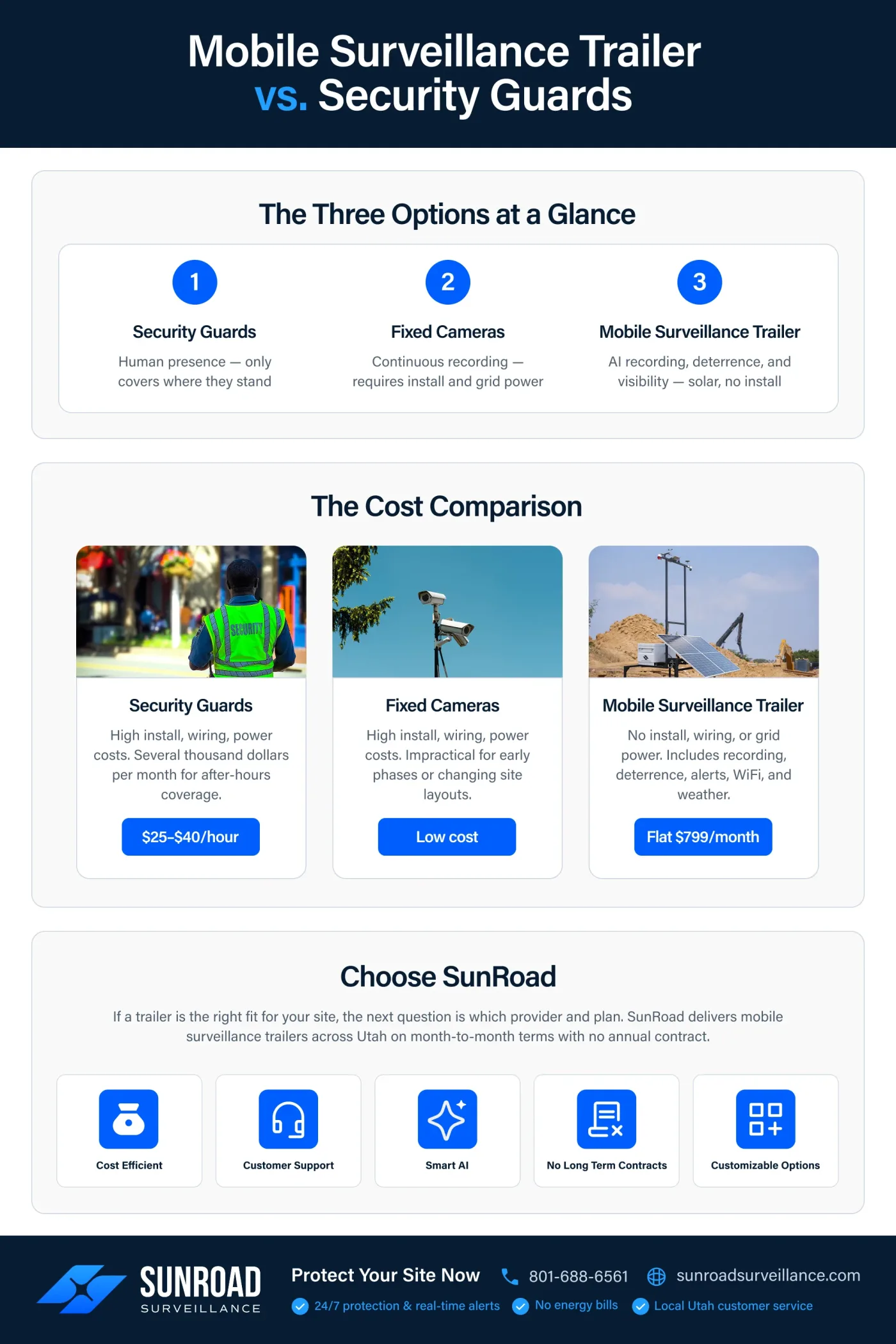
The Three Options at a Glance
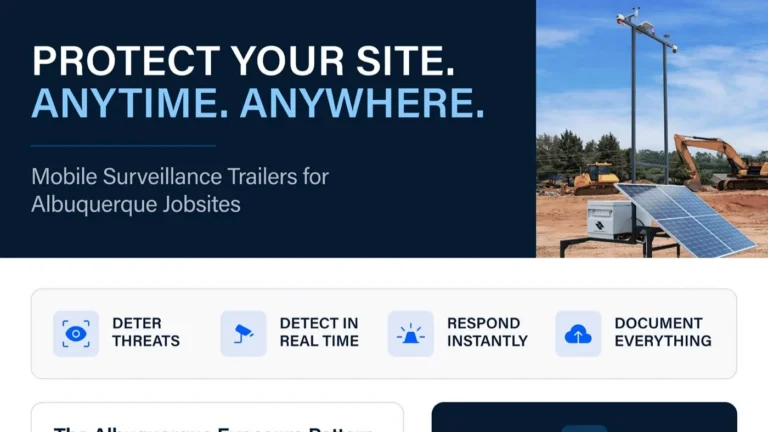
Before getting into cost, it helps to understand what each option fundamentally is. Security guards provide a human presence that can respond to incidents and make judgment calls, but only cover where they physically stand. Fixed cameras provide continuous recording from set positions, but require permanent installation and grid power. A mobile surveillance trailer combines continuous AI-powered recording, active deterrence, and remote visibility in a single solar-powered unit that deploys without installation and moves with the project.
The Cost Comparison
Cost is usually the deciding factor — and it is where the differences are starkest.
Security Guards
According to the U.S. Bureau of Labor Statistics, security guards earn a median wage that, once you factor in agency markup, overtime, and the premium for overnight and weekend coverage, typically runs $25 to $40 per hour for contracted construction site security. For around-the-clock coverage of a single site — the window when most theft occurs — that math adds up quickly. A single guard covering nights and weekends can cost several thousand dollars per month, and one guard cannot watch an entire large site at once.
$25–$40/hour for contracted construction site security — several thousand dollars per month for after-hours coverage
Source: U.S. Bureau of Labor Statistics / industry contract rates
Fixed Camera Systems
Fixed cameras have a lower ongoing cost than guards but carry significant upfront and structural costs: installation labor, wiring, mounting infrastructure, and a connection to grid power and internet. On a construction site — where power may not arrive until well into the project and where the layout changes constantly — these requirements make fixed systems impractical for the early phases when sites are most exposed. And once installed, they do not move.
Mobile Surveillance Trailer
A mobile surveillance trailer carries a predictable flat monthly cost. SunRoad’s units Starting at $799 for the Standard plan, with no installation cost, no wiring, and no dependency on grid power. That single monthly figure covers continuous recording, active deterrence, real-time alerts, on-site WiFi, and a weather station — capabilities that would require combining multiple separate systems otherwise. For most construction sites, the monthly cost of a trailer is a fraction of what round-the-clock guard coverage would cost.
The Coverage Comparison
Cost only matters in the context of what each option actually delivers. Here the differences are just as significant.
- Continuous coverage: A guard covers one location at a time and needs breaks, shift changes, and time off. A mobile surveillance trailer’s cameras record continuously, 24/7, with no gaps — and the PTZ cameras cover 328 feet with a 360-degree view.
- Active deterrence: All three options provide some deterrence, but a trailer’s motion-activated floodlights, 105-decibel siren, and red and blue alarm lights create a visible, automated response the moment activity is detected — without relying on a guard being awake and in the right place.
- Real-time notification: A trailer sends an instant alert with footage to the project manager’s phone when motion is detected after hours. A guard might call; a fixed camera simply records for later review.
- Operational visibility: This is where the trailer pulls decisively ahead. Beyond security, it logs who showed up, what vehicles are on the property, and how the project is progressing — all searchable from the app. Neither guards nor fixed cameras provide this kind of day-to-day operational intelligence.
Why the Comparison Matters: The Theft Data
The reason this comparison matters at all comes down to a persistent industry problem. According to the National Insurance Crime Bureau (NICB) and the National Equipment Register, construction site theft costs the U.S. industry between $300 million and $1 billion annually, with more than 11,000 equipment theft incidents reported each year. Fewer than 1 in 5 stolen pieces of heavy equipment is ever recovered.
$300M–$1B in annual U.S. construction theft — fewer than 1 in 5 stolen items recovered
Source: NICB / National Equipment Register
Because most theft happens overnight and on weekends, the option that provides continuous, automated, after-hours coverage — without the gaps and cost of human staffing — has a structural advantage. For a deeper look at the numbers, see our construction site theft statistics breakdown.
When Each Option Makes Sense
No single option is right for every situation. Security guards make sense when a site genuinely needs human judgment and physical response — access control at a staffed entry, for example. Fixed cameras make sense for permanent facilities with established power and a layout that will not change. But for the typical construction site — temporary, evolving, often without early-phase power, and needing both security and operational visibility — a mobile surveillance trailer addresses the widest range of needs at the lowest effective cost.
Choosing a Mobile Surveillance Trailer
If a trailer is the right fit for your site, the next question is which provider and plan. SunRoad delivers mobile surveillance trailers across Utah on month-to-month terms with no annual contract. For region-specific service, see mobile surveillance trailer rental in Utah, or explore your city: Salt Lake City, Provo, Ogden, Lehi, St. George, Logan, and Sandy. You can also see the full pricing breakdown.
→ Schedule a Free Demo: sunroadsurveillance.com/schedule-a-demo/
Frequently Asked Questions
Is a mobile surveillance trailer cheaper than hiring security guards?
For around-the-clock coverage, generally yes. Contracted construction site security typically runs $25 to $40 per hour once agency markup, overtime, and overnight premiums are factored in, which reaches several thousand dollars per month for after-hours coverage of a single site. A mobile surveillance trailer carries a flat monthly rate with no installation cost and provides continuous 24/7 recording.
What can a mobile surveillance trailer do that fixed cameras cannot?
A mobile surveillance trailer requires no permanent installation, wiring, or grid power, so it operates during early construction phases before utility power reaches the site. It also repositions anywhere on the site as the project evolves, and it adds on-site WiFi, a weather station, and active deterrence features that fixed camera systems do not include.
When do security guards still make sense on a construction site?
Security guards make sense when a site genuinely requires human judgment and physical response, such as staffed access control at an entry point. Fixed cameras suit permanent facilities with established power and a layout that will not change. Many sites use a combination rather than a single approach.
How quickly can a mobile surveillance trailer be deployed on a job site?
Delivery and setup take about 30 minutes. Because the unit is solar powered with battery backup and connects over cellular, it requires no electrician, no wiring, and no utility hookup, so a site can be under active monitoring the same day the unit arrives.
Sources
Related Content